
©️ By Sophie Lewis | The Grooming Files | The Indie Leaks | @realtalkrealtea
The Message That Changed Everything
I didn’t ask for this.
I’ve spent years researching predators, interviewing survivors, documenting cases, uncovering institutional rot.
But this was something else entirely.
This was direct contact. Voluntary. Repeated. Unprovoked.
He reached out through my page — the kind of message you scan past at first. Casual.
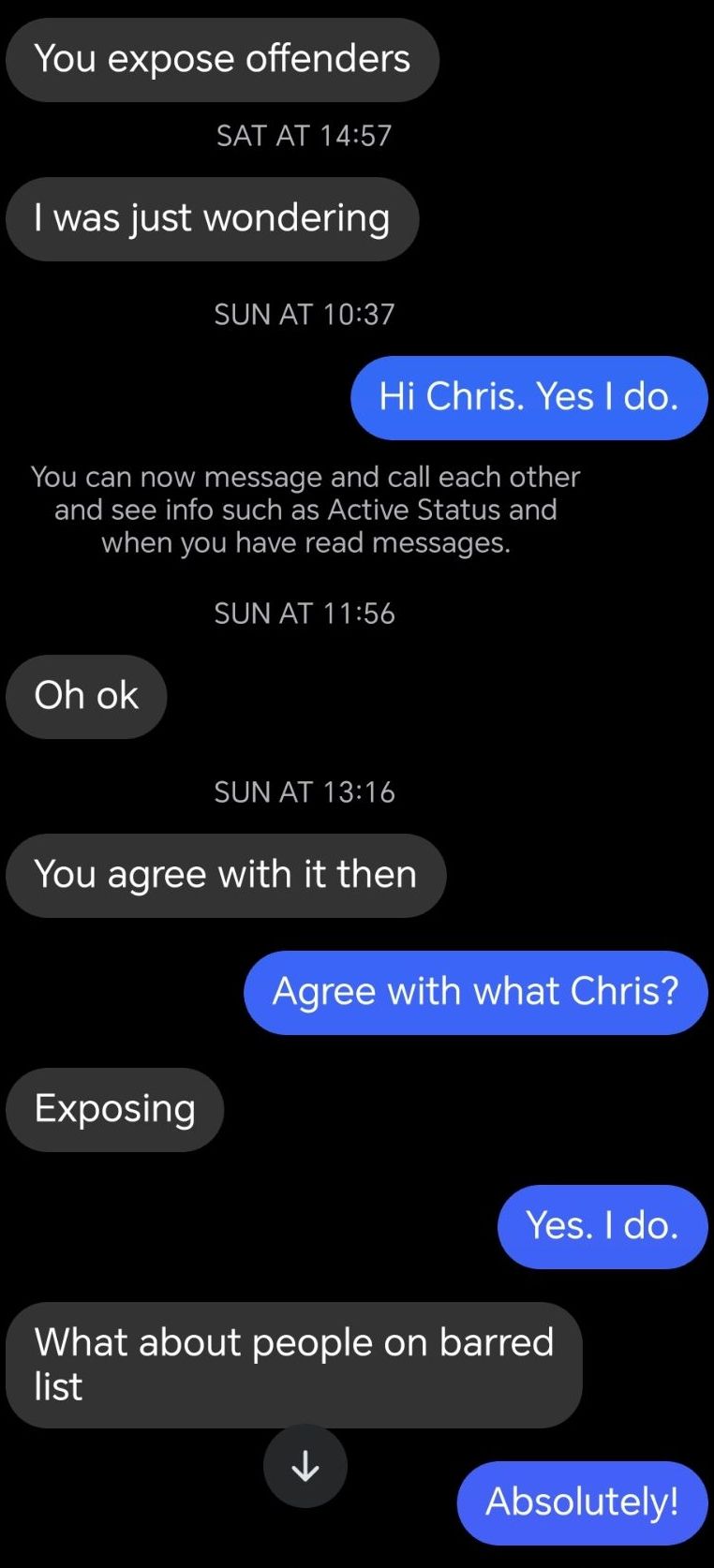
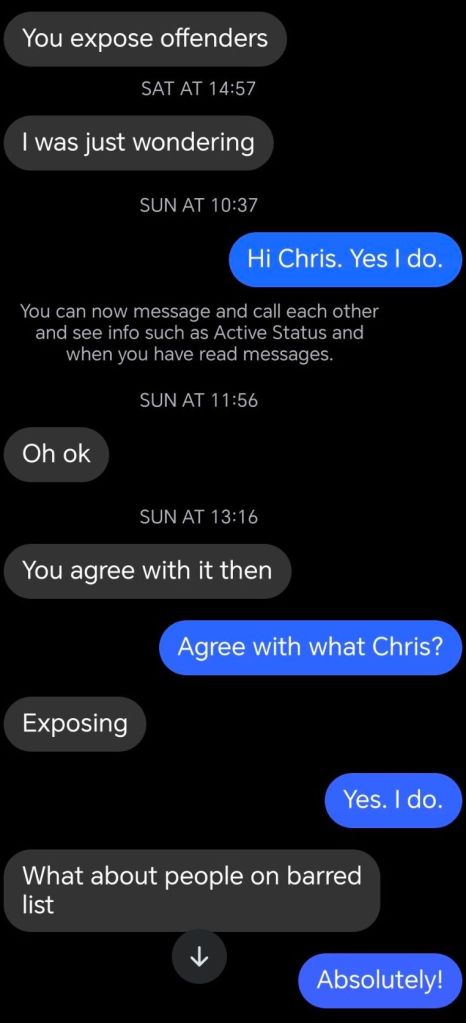
“Do you believe in exposing people on the sex offender register?”
It didn’t even sound personal. It read like curiosity.
I replied honestly. Like I always do.
“Yes. I do.”
It was only after a few more messages that the truth dropped —
He wasn’t asking about someone else.
He was talking about himself.
“I used to talk to underage kids on Xbox. I got done for it. Everyone in my old town knows. I lost everything.”
“I’ve never told anyone the full story. I don’t know why I’m telling you.”
“I want to tell someone.”
“I need help.”
“You look genuine.”
And suddenly I was in it.
Not a journalist documenting a case.
Not an activist sharing survivor stories.
But a survivor being chosen — handpicked — by a predator who wanted to confess.
That moment changed everything.
Why Me?
I asked myself this over and over.
Why did he choose me?
Because I write openly about grooming?
Because I don’t flinch when the truth gets graphic?
Because I walk the line between survivor and speaker, activist and investigator?
Whatever the reason, he decided I was “safe.”
Safe enough to disclose to.
But not safe enough to respect.
He wanted relief, not redemption.
A stage, not accountability.
I knew what I was dealing with almost immediately.
The language was fractured — a mix of guilt, performance, self-pity, and control.
He didn’t say, I hurt people.
He said, I lost everything.
He didn’t say, I want to own it.
He said, I want to feel better.
And yet —
I stayed in the conversation.
Why?
Because I’ve never seen it done before.
Not like this.
Not a predator in open dialogue with a survivor — under full consent, on record, asked questions no one else dares to ask.
I realised this wasn’t just an interaction.
It was a case study.
A psychological profile unfolding in real time.
A rare opportunity to look the predator in the face — not with pity, but precision.
And more than that —
I felt a duty to document it.
What Followed Was Three Days of Psychological Descent
Three days of speaking with him.
Text. Voice. Video.
Consent repeated.
Boundaries laid down.
Questions asked — not once, but over and over.
And with every hour that passed, I saw more than just the man.
I saw the pattern.
The tactics.
The fear.
The ego.
The obsession with being seen, but never truly seen.
It started as a “story.”
But it turned into a survival exercise.
For me.
Because the moment he attached himself to me, my body started to shut down.
Headaches. Brain fog. Cold sweats.
A full-body trauma response — before I even realised what was happening.
I hadn’t let the predator in.
But I’d opened the door to what they carry.
And once you let it in… you can’t just shake it off.
The Weight of Saying Yes

They think the worst part is reading what he said.
Hearing what he admitted to.
Watching the interview.
It’s not.
The worst part came after I said yes.
After I agreed to keep speaking.
To listen.
To ask the questions.
To create the space.
To document this thing in full.
That “yes” sounded so small at the time.
But it cracked something open inside me that hasn’t stopped leaking since.
What No One Tells You
No one tells you what it does to your body —
sitting across from the type of man who once shattered you, even if it’s not him exactly.
No one tells you what it’s like to keep your voice steady
while your chest tightens like a vice.
To type clearly
while your stomach clenches like it remembers every violation.
To analyse a man’s words
while your own trauma starts crawling up your spine.
For three days I was a shell.
A walking trauma response.
I was cold — freezing, even under blankets.
Head pounding.
Shaking hands.
Clenched jaw.
Spaced-out thoughts.
My body was in danger.
Even though I wasn’t.
Even though I knew I was the one in control.
That’s what trauma does.
It doesn’t care about logic.
It remembers before you do.
The Cost of Curiosity
Some people will ask why I kept going.
Why I didn’t just block him.
Why I didn’t hand it over to someone else.
Why I didn’t walk away when it got too much.
And the truth is — I tried.
I thought about stopping. I even planned to.
But then he kept talking.
And what he said was rare. Raw. Wrong.
But real.
I knew I wasn’t just hearing his story.
I was hearing a template.
A pattern.
The same psychology behind thousands of unsolved cases and system failures and hushed-up reports.
I was watching what society doesn’t understand — not because it’s hidden,
but because no one’s ever stayed in the room long enough to document it.
I was exhausted. Sick.
But I knew that if I walked away now, this thing would disappear into silence again.
And that silence?
It protects no one.
It educates no one.
It changes nothing.
The Survivor Paradox
There’s this myth that once you “heal,” predators lose their power over you.
But healing isn’t a shield.
It’s a mirror.
And mirrors don’t deflect — they reflect.
Every time he spoke,
I saw reflections of those who hurt me.
The excuses.
The justifications.
The obsession with being understood but never held accountable.
He reminded me of the ones who lied to my face and called it care.
The ones who confused attention with safety.
The ones who got away with it because they were “nice” and “broken” and “just needed help.”
And that’s why I kept going.
Because I wasn’t just speaking to him.
I was speaking to all of them.
Through him.
Past him.
For every survivor who never got to ask:
“Why did you do it?”
And every child who deserved a world where that question never had to exist in the first place.
The Performance of Remorse

He didn’t open with truth.
He opened with testing.
“You expose people, right?”
“Do you think the word ‘nonce’ is fair?”
“I lost everything.”
Like a toe in the water before the plunge.
Before he told me anything, he wanted to know what I’d let him get away with.
That’s the first thing I learned: Remorse is rarely the starting point.
The starting point is fear. Ego. Control.
A need to shape the stage before stepping on it.
He didn’t offer a confession.
He offered a preview — laced with disclaimers, vagueness, and self-preservation.
“I just need to talk to someone.”
“I’ve never told the full story.”
“I’m not like the rest.”
Over and over, he returned to the same refrain:
“I lost everything.”
Not: “I hurt children.”
Not: “I destroyed innocence.”
Not: “I did this.”
Just what he had to endure.
He Wasn’t Telling Me His Story — He Was Auditioning for It
Every line felt like it was written for effect.
He played between vulnerability and deflection, honesty and ego.
Like he wanted to appear broken enough to gain sympathy
but not broken enough to warrant real consequences.
He asked me if “nonce” was fair.
When I said I didn’t use that word, he sighed with relief.
“At least you won’t say it in front of me.”
Control. Again.
This wasn’t about being understood.
It was about making me behave the way he wanted.
Shaping how I saw him.
Even in “confession,” he was still managing perception.
He Said He Wanted the Truth Out — But Only on His Terms
He said he wanted to be exposed.
Said people “had the right to know.”
But the moment I held the mirror up to him —
He flinched.
He stalled. Delayed. Disappeared.
He agreed to the interview. Then asked to cancel. Then reappeared.
Then panicked when I reminded him it would be public.
“Will I be known as that word now?”
“I just want to sleep better.”
“Please don’t block me.”
What he wanted was performance without exposure.
A way to feel “cleansed” without facing shame.
To speak his guilt, but not sit in it.
But that’s not how this works.
The Hardest Truth? This Was Never About Redemption
Not once did he say:
“I want to help survivors.”
“I want to prevent this happening again.”
“I want to own what I did.”
Every reason he gave for speaking?
Was about himself.
To feel better.
To sleep better.
To “not hide anymore.”
Not once did he ask what it cost me to listen.
Not once did he acknowledge the emotional violence of this interaction.
He wanted the image of remorse.
Not the reality of it.
The Interview That Broke the Illusion

For three days, he circled the drain.
Pleading, confessing, backtracking, repeating.
He wanted to talk.
He wanted to be seen.
He wanted exposure — until it came time to face it.
When I finally said, “Let’s do the interview,”
he agreed.
He gave consent.
He said he was ready.
He wasn’t.
The Setup
It was clear.
This would be a recorded interview.
He would be asked questions — some of them hard, all of them fair.
The aim? To document the predator mindset from the inside.
Not to excuse it.
Not to soften it.
To reveal it.
He was nervous.
He asked if his face would be visible.
If I would use his name.
If I’d promise not to “say that word” — the one he couldn’t handle.
He said:
“Do what you think is best. I trust you.”
But it was never about trust.
It was about control disguised as consent.
And when the first question came — just one —
he dropped out.
The First Question: A Mirror Too Clear

“What are you? Not by label. Not by law.
In your own words — what are you?”
That was it.
Not an attack.
Not a trap.
Just a request for truth — from his own mouth.
But predators don’t speak in mirrors.
They speak in fog.
And this question?
It pierced the fog.
He left.
Vanished.
The man who “wanted to be exposed,”
who begged me to help him feel clean,
couldn’t sit with the truth he already knew.
What That Silence Told Me
He didn’t need more time.
He didn’t need space to prepare.
He needed escape.
Because when survivors reclaim the power dynamic —
when we become the interviewer,
the documenter,
the analyst —
it dismantles their fantasy.
He couldn’t control me.
He couldn’t script me.
He couldn’t manipulate what was coming.
So he ran.
That silence?
It said more than any answer ever could.
It said:
“I’m not here for truth.
I’m here to perform until it hurts.”
And the moment it hurt — he folded.
Why This Matters — And What It Tells Us About Accountability
He said he wanted to speak.
He said people had a right to know.
He said he’d do the interview.
And in the end, he did.
But what the camera captured wasn’t insight.
It wasn’t transformation.
It wasn’t even truth.
It was a man stalling in real time — face to face with the thing he swore he wanted.
That 17 minutes told me more than any 17-page confession could.
It showed me how far removed “accountability” is from our systems, our conversations, our culture.
Accountability Isn’t a Confession
Saying “I did this” isn’t the same as standing in the wreckage and owning every piece of it.
He wanted exposure, but only the kind he could stage-manage.
He wanted to talk, but only on his terms.
He wanted to feel seen, but never held.
And this isn’t just about him.
This is about the culture that shaped him —
that taught him remorse is a look, not a reckoning.
That you can call yourself “changed” without confronting a single consequence.
That if you cry enough, shake enough, say “I’m struggling” enough,
someone will hand you sympathy
and skip over the damage.
We see it in institutions.
In churches, courts, schools, councils.
We call it rehabilitation. But it’s performance.
It’s damage control. It’s “healing” without the howl.
This Is What a Survivor’s Lens Looks Like
I didn’t do this interview for shock value.
I didn’t do it for clicks.
I did it because we are missing the entire psychology behind this crisis.
We keep documenting outcomes.
Sentences. Trials. News headlines.
But we don’t document the mind behind the act.
The avoidance. The justifications. The ritualised dodging of truth.
The refusal to name yourself honestly.
And until we face that, we’ll keep getting
new names,
same crimes,
same silence.
This isn’t about redemption.
It’s about excavation.
I didn’t want his story.
I wanted the mechanism.
The engine beneath the excuses.
And I got it.
Seventeen minutes of everything he couldn’t say.
And three days of everything he couldn’t hide.
The Silence Around Us — And the Fire It Sparked in Me
For three days, I walked through a minefield.
Not just of his words — but of my own memories.
My own nerves. My own trauma, triggered by proximity to someone who reminded me of what I lived through.
I carried it.
I carried him.
And I carried every moment of this experiment in silence, because I knew the system wouldn’t.
I pitched the story.
I offered the truth.
I put a piece of my soul on the line — and nobody answered.
The press went quiet.
The inbox stayed empty.
The message?
“This is too much. Too uncomfortable. Too real.”
But that’s exactly why I’m still writing.
Let Me Be Clear — This Is Not About Him
This was never about giving him space.
This was about:
- What happens when a survivor stares down the monster and doesn’t flinch.
- What’s revealed when you cut the script and let silence speak.
- What predators do when the mask of manipulation stops working.
And what systems do in response?
They look away.
Because this kind of truth? Doesn’t sell ads. Doesn’t win awards. Doesn’t sit nicely on a homepage between weather updates and celebrity gossip.
But this truth is ours.
And I won’t let it rot in drafts and unread emails.
I’m Not Waiting for Permission Anymore

I am a survivor.
I am a journalist.
And I am done softening my tone for platforms that fear discomfort more than they fear complicity.
This isn’t entertainment.
This is evidence.
Of how predators behave.
Of how they manipulate remorse.
Of how they test boundaries even while claiming to be reformed.
And it’s evidence of something else, too:
That when a survivor takes control of the story,
the narrative doesn’t just shift — it detonates.
This was never about justice for him.
It was about power for us.
A New Kind of Justice. A New Kind of Journalism.

I didn’t write this to be palatable.
I didn’t conduct this interview to be neutral.
And I sure as hell didn’t survive what I did just to repeat the same broken cycles.
This is journalism with its gloves off.
This is justice with teeth.
This is what happens when survivors stop waiting for the system to speak — and start documenting the silence themselves.
He said he wanted to be exposed.
So I showed him the mirror.
He wanted to be seen.
So I lit the fucking spotlight.
He wanted to feel better.
And I gave him the truth.
Not one person can read this and say we’re overreacting.
Not one person can scroll past and say “Well, it’s complicated.”
It’s not complicated. It’s uncomfortable. And that’s the difference.
I’m Not Just a Survivor. I’m a Record-Keeper.
This is not the last time I’ll do this.
And it might not even be the hardest.
Because I’ve realised something:
The most radical thing a survivor can do is ask the questions nobody else will.
And then answer them ourselves — with evidence, with rage, with clarity, and with truth.
This wasn’t just an exposé.
It was an experiment.
A case study.
A psychological breakdown of what predator performance looks like up close.
And no one can unsee it now.
If the Press Won’t Print It — I Will.
If editors can’t stomach it, I’ll publish it here.
If platforms want “sensitive” and “toned-down,” they’ll get silence from me instead.
Because I don’t write for headlines.
I write for the girl I used to be — the one who was never given a warning.
I write for every survivor who was told to be quiet, to be kind, to be careful.
I write for the children still out there, scrolling, gaming, talking — being hunted while no one watches.
Well, I’m watching now.
And I won’t look away.
This is the new frontier.
Survivor-led. Truth-driven. No compromise.
If this shook you —
good.
Now do something with it.
Appreciate my work? Here’s how you can support it.
Everything I write — from exposés to reflections — is created independently, with no funding, no sponsors, and no backing. Just me, working across three platforms to share stories, challenge silence, and expose what others won’t.
If my work has moved you, informed you, or made you feel less alone — and you’d like to help me keep going — I’ve created a GoFundMe to support the growth and sustainability of this work.
Any support helps — whether it’s towards better equipment, secure hosting, emotional recovery, or just the time and space to keep telling the truth.
There’s no pressure. Just deep gratitude for reading, sharing, and being here.
Support the work here.
With love and fire — Soph 🖤


 The Grooming Files
Leave a reply to Three Days with a Predator – Part One – Real Talk, Real Tea Cancel reply