
How Facebook Is Hosting a Grooming Pipeline in Plain Sight
The Grooming Files | Investigative Report | April 2026
Sophie Lewis | NUJ Member | Investigative Journalist | The Grooming Files | thegroomingfiles.com
I opened Facebook this morning and the very first thing in my feed stopped me cold.
Not a news story. Not a meme. A grown woman with a dummy in her mouth, posting in a public group called DD/LG Daddy and Me, telling strangers she has a “Daddy” and wants to make friends.
WTAF.
I’m an investigative journalist. I have a degree in Social Sciences, specialising in Criminology and Forensic Psychology. I’ve spent years documenting how predators operate, how institutions fail, and how grooming doesn’t always announce itself. I know what these structures look like not from textbooks, but from sitting across from the men who live inside them.
So when I say what I found in that group is a textbook grooming pipeline operating in plain sight on one of the world’s biggest platforms, I’m not just angry.
I’m qualified to be angry.
And I have the receipts.
Here’s what Facebook is hosting. Publicly. Right now.
“On Facebook, content moderation doesn’t have much impact on user experience because it happens too late.”
— Laura Edelson, Assistant Professor of Computer Sciences, Northeastern University, 2025
The Storefront
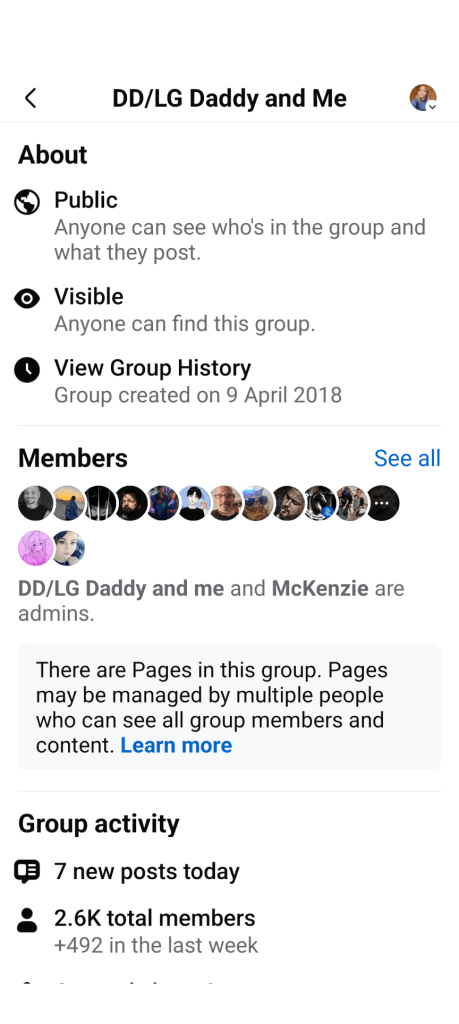
There is a Facebook group called DD/LG Daddy and Me. It was created on 9 April 2018. It has been running publicly, visibly, without meaningful intervention for eight years.
As of this morning it has 2,600 members. It gained 492 new members in the last week alone. There were 7 new posts today before I finished my tea. It is not a relic. It is not fringe. It is growing fast and Facebook’s own group description tells you everything you need to know about who can see it:
“Public. Anyone can see who’s in the group and what they post.”
“Visible. Anyone can find this group.”
No membership required. No age verification. No barrier of any kind. Just there in the feed, in the search results, in the open for anyone to stumble across. Including me, this morning, having not searched for it.
What happens inside it is this: adults perform infancy.
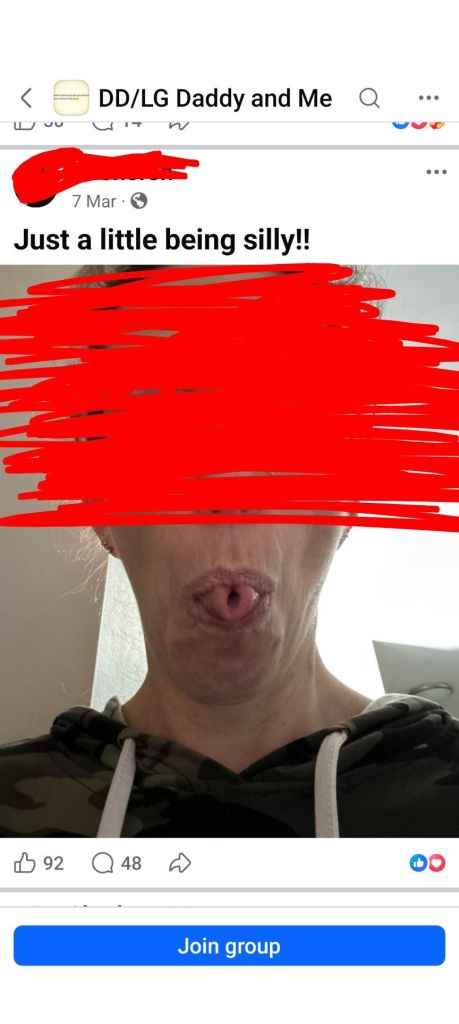
They post photographs of themselves with oversized dummies in their mouths. They describe their “little age” not their actual age, but the age of the child they become during sexual or intimate roleplay with a dominant partner they call “Daddy.” They ask strangers on a public forum whether they should buy tape-on nappies or pull-ups. They introduce themselves the way a child might on the first day of school, listing favourite colours, cartoon preferences, pets and then, at the bottom: Looking for: A Daddy.
This is DD/LG. Daddy Dom/Little Girl. A subculture that positions itself at the edges of BDSM. Consensual, adult, boundaried, harmless. Its defenders will tell you the children aren’t real. The ages are symbolic. Nobody is being forced.
I’m going to tell you why that argument falls apart not theoretically, but evidentially. Because I have spent three years interviewing the men for whom these dynamics are not separate from their attraction to children.
In some of the cases I have documented, they are not separate at all. They are the same compulsion expressed through different channels.
The Pipeline — What My Research Actually Shows
Let me say plainly what the mainstream conversation around kink communities refuses to.
The sissy/Dom punishment dynamic. The age regression roleplay. The public exposure seeking. The dominant “Daddy” and the infantilised “little.” These are not always distinct communities with firm walls between them. For a documented subset of men, they are nodes on the same circuit. The same compulsion cycling through different channels, dressed up in different language depending on which platform they’re on and which community they’re performing for.
I know this because I have interviewed them.
Over three years of primary source research, conducted with full informed consent protocols and trauma-informed methodology, I have documented a previously unrecognised offender pattern: exposure-seeking behaviour in individuals with active sexual ideation about children. Men who seek out dominant punishment, including sissy dynamics, humiliation rituals and public confession as part of a shame-arousal cycle directly linked to their attraction to children. Men who use the language and aesthetics of adult kink communities to manage, displace and critically fuel urges that are not adult at all.
One of those men is Eddie B.
Eddie contacted me voluntarily in August 2025, twenty months into an active CPS investigation for allegations including receiving and sending indecent images of children, and upskirting. He said he wanted to help me “expose people who prey on children online.”
What he actually did was hand me one of the most clinically significant interviews I have conducted.
In his own words, across a fully consented and documented interview:
He admitted recurring sexual arousal at schoolgirls in uniform, “feeling can come back sometimes when I see schoolgirls.”
He described his darkest thought as “having sex with a schoolgirl in uniform and other things.”
He confirmed he visits a dominatrix, dressed as a sissy, to be punished for what he called his “nawty feelings.”
He confirmed that speaking to me, a journalist who exposes predators, gave him the same rush as those sessions. His word: “Yes.”
He stated his greatest fear is not prison. It is “people finding out.”
And when I asked whether he could stop: “Feelings are feelings. You don’t want them but you get them. So no, you can’t change it.”
This is what a pipeline can look like in practice. Not theory, documented behaviour. A case in which the sissy dynamic, the Dom punishment ritual, the public exposure seeking and the sexual ideation about children are not separate things. They are the same compulsion cycling through different channels.
The DD/LG group I found this morning is one of those channels. I am not claiming every person in this group fits that profile. I am saying the structure mirrors environments I have already documented being used by men who do.
The Architecture
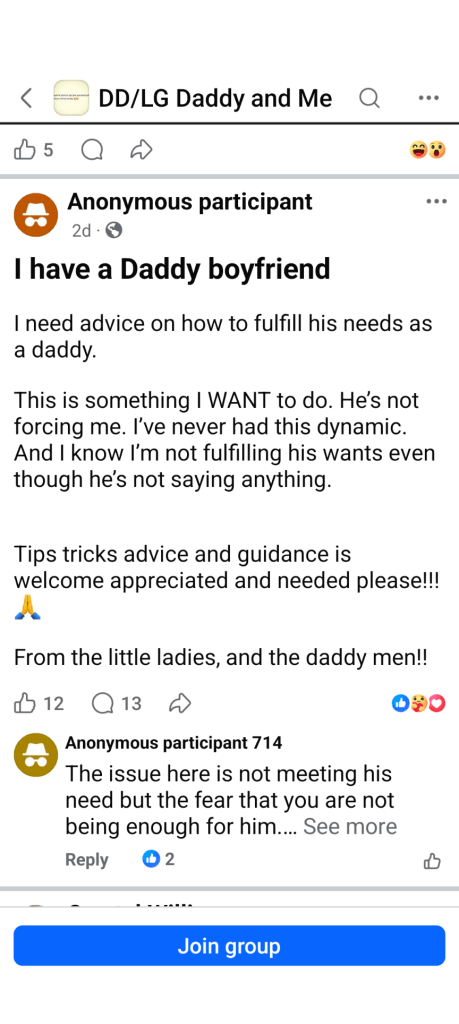
Through years of investigative work I’ve developed what I call the Grooming Architecture thesis. The central argument: grooming does not require a specific victim. It requires a structure. A set of conditions that normalise access, lower resistance, build dependency and reward compliance. Grooming is not an event. It is an environment.
DD/LG Daddy and Me is a structure that closely mirrors what I would identify as a grooming architecture, and it has been permitted to run for eight years.
Here is how each element functions.
It establishes an age hierarchy as the foundation of intimacy.
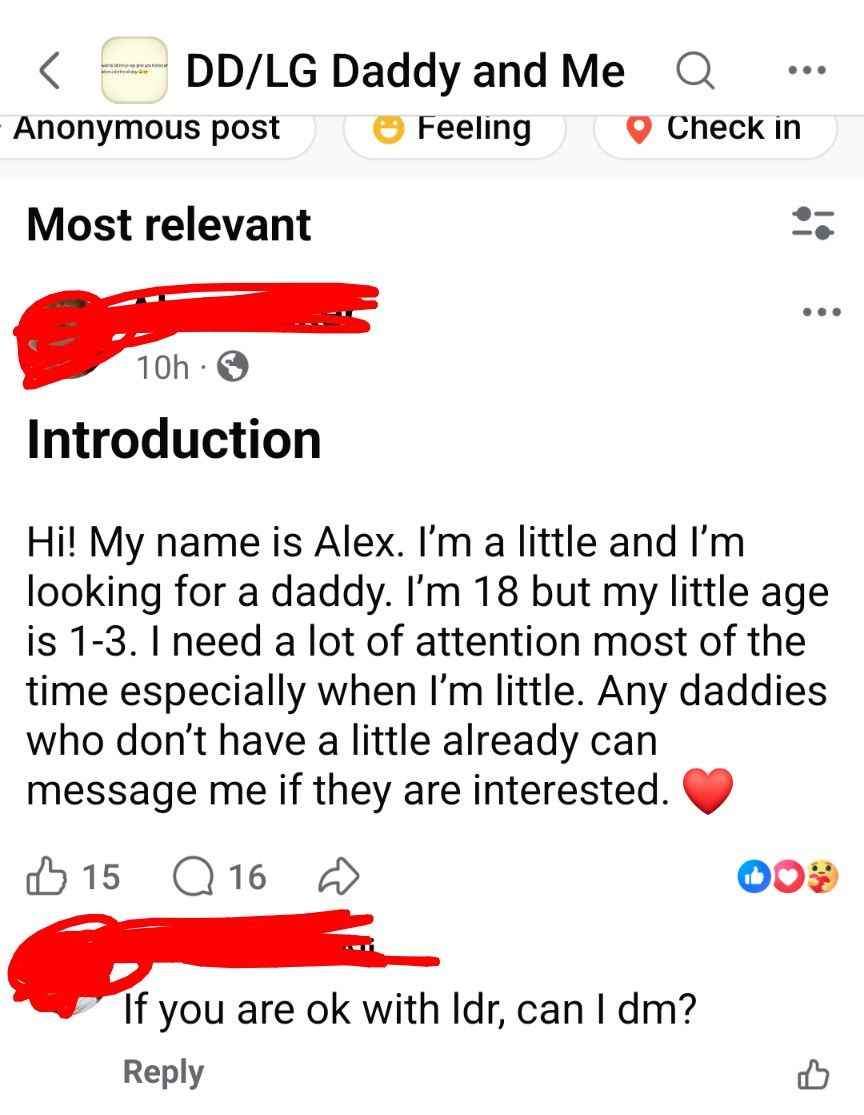
Every member declares a “little age” a numerical regression to childhood. An 18-year-old states hers as 1-3. A 26-year-old leads with hers. A 31-year-old lists hers as 7-8. A 41-year-old identifies hers as 4. These are not incidental details. They are the primary currency of the group.
Sit with that. A 41-year-old woman. Little age: 4.
It positions adult men as authority figures over child-coded women.
Men introduce themselves as “Daddy.” A 31-year-old announces himself as a “Dom Daddy” seeking his “little.” A 32-year-old from Queensland describes himself as a “gentle Daddy with a particular emphasis on self care and fun activities.” These are not partners seeking equals. These are authority figures recruiting dependants.
It uses a public platform to conduct private recruitment in real time.
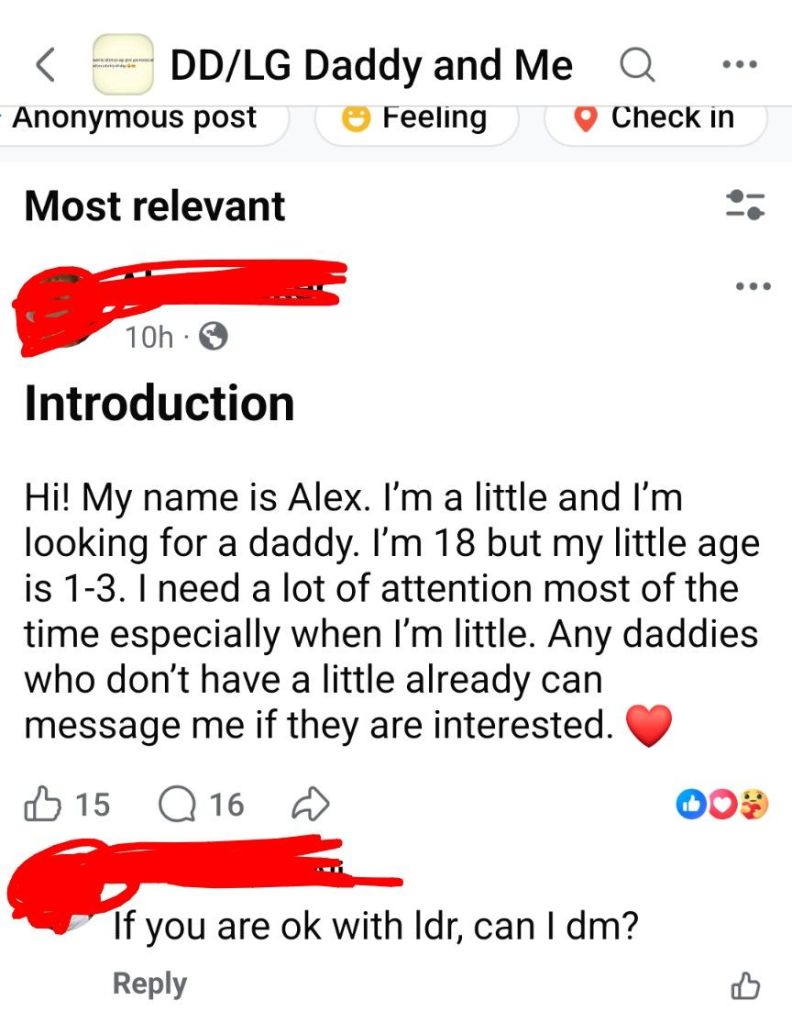
Within minutes of an 18-year-old posting her introduction, little age 1-3, inviting daddies to message her, multiple men had responded publicly and moved to private messaging.
All timestamped. All visible. All on Facebook. Zero moderation.
It uses anonymity as concealment, not privacy.
“Only posted anon because group is public and some family doesn’t know I’m in this lifestyle.”
That is not privacy protection. That is managing who knows what.
It normalises total dependency and anxious compliance.
“I know I’m not fulfilling his wants even though he’s not saying anything.”
Children don’t negotiate. Children comply.
It contains its own evidence of platform failure.
On one post, Facebook’s algorithm flagged comments as potentially offensive and hid them behind a content warning. The post itself remained live and publicly accessible.
The platform noticed something. Then did nothing consequential about it.
This is not simply a kink community that happens to be on Facebook. It is a structure that closely mirrors what I would identify as a grooming architecture, and Facebook has permitted it to run publicly for eight years.
That distinction is not semantic. It is everything.


The Platform Failure

In January 2025, Mark Zuckerberg told the world that Meta’s content moderation rollbacks represented “a tradeoff” — that the platform would “catch less bad stuff” as a result.
He said it out loud. They will catch less. And they did it anyway.
The rollbacks stripped third-party fact-checkers. Weakened hate speech protections. Moved trust and safety teams out of California. Replaced independent oversight with a crowd-sourced system modelled on Elon Musk’s X. The changes arrived days before Donald Trump’s inauguration, following months of Zuckerberg’s visible effort to align himself with the incoming administration.
In 2026, Facebook is a structurally less safe platform than it was two years ago. And it was already failing.
Research from Northeastern University, published in 2025, found that Facebook posts removed for policy violations had already reached at least three-quarters of their predicted audience before being taken down. “On Facebook, content moderation doesn’t have much impact on user experience because it happens too late,” concluded lead researcher Laura Edelson. By the time a post is reviewed, if it is reviewed at all, the reach is done. The contact is made. The recruitment has happened.
Meanwhile governments scramble to patch what platforms refuse to fix. Australia’s under-16 social media ban came into effect December 2025. Early reports found teenagers bypassing age verification within seconds. The UK’s Online Safety Act requires platforms to assess harmful content and implement age checks. Enforcement remains inconsistent. UNICEF stated in December 2025: “Regulation should not be a substitute for platforms investing in child safety.”
None of this catches what I have documented here. DD/LG Daddy and Me contains no illegal content by Facebook’s current standards. Its members are, as far as can be evidenced, adults. There is no legal mechanism currently sharp enough to catch it.
And yet, a publicly visible group, created April 2018, running eight years, 2,600 members, nearly 500 new ones this week, hosting infant-coded sexual recruitment in a globally visible space, with a moderation system that acts too late to matter, on a platform that just confirmed it will catch even less going forward.
The group is still there. Still public. Anyone can find it. Facebook’s algorithm served it to me this morning without me looking for it.
At best, that is a system failing as designed. At worst, it raises serious questions about what is being tolerated.
Why “They’re Adults” Is Not Enough
I’m going to answer the consent argument directly, because I’m done with it being treated as unanswerable.
Yes. The members of this group are, as far as can be documented, adults. Yes, age regression and power exchange between consenting adults is legal. I am not disputing that.
Here is what I am disputing.
I have documented, through primary source research, that for a subset of men these dynamics are not separate from attraction to children. Eddie B is not an isolated concern in my reporting. He is one data point in a wider pattern I have documented across multiple cases, men who use sissy dynamics, Dom punishment rituals, age regression communities, and public exposure spaces as nodes in a single compulsion loop that has child-coded sexual ideation at its centre.
The community says the children are not real.
My research suggests that for some men moving through these spaces, that distinction does not hold in the way defenders claim it does.
The community says this is consensual adult kink.
My research says for some of the men in these spaces, the adult framing is the disguise, not the reality.
The community says nobody is being harmed.
My research says the harm is structural, cumulative, and in some cases already documented.
The Exposure Spiral, a framework developed through this publication’s investigative work, maps how harmful dynamics expand their reach through incremental normalisation. Each step slightly further than the last. Each community slightly more accepting. Each platform slightly less willing to intervene. The DD/LG community on Facebook is not the end of that spiral. It is a node within it. A place where the template is established, the language is learned, the norms are rehearsed, in public, with an audience, and with the door left wide open for the men Eddie B represents to walk through it.
There are children on Facebook right now. Every attempt to exclude them has failed. They have access to the same search bar. The same recommendation algorithm that put this group in my feed this morning without me searching for it.
I have interviewed a man who told me, in his own words, that the sissy punishment dynamic and his sexual ideation about schoolgirls are part of the same cycle. Who confirmed that confessing to a journalist gave him the same rush as paying a dominatrix to punish him dressed as a sissy.
That man found his way into communities built around shame, exposure, roleplay, and power imbalance. This group shares structural features with those environments.
Tell me again this is just kink.
What Needs to Happen
Public groups hosting infant-coded sexual recruitment content should not be publicly visible on a platform that cannot reliably exclude children. The “they’re adults” defence collapses the moment you acknowledge that the audience cannot be guaranteed adult, and that the content is built around infant and toddler framing with no barrier to access whatsoever.
Facebook should be required, not asked, required, to make groups of this nature private by default. Genuine age verification should be a condition of access to any group whose content is built around age regression dynamics. The recommendation algorithm should not be surfacing this content in open feeds.
Meta’s January 2025 decision to strip back moderation should be under active scrutiny from every regulator with jurisdiction, Ofcom, the ICO, and EU Digital Services Act enforcement bodies.
But legislation alone will not fix this. The Online Safety Act will not catch it. The Australian ban did not catch it. Zuckerberg has told you himself the platform will catch less now, not more. UNICEF has said regulation is not a substitute for platforms choosing safety.
Facebook has made the opposite choice. Explicitly. On the record. With Zuckerberg’s name on it.
And somewhere in a group that has been running publicly for eight years, a man is queuing in the comments to DM an 18-year-old who just said her little age is 1-3. Another is posting anonymously because his family does not know. Another may be reading that thread through a lens the platform cannot see, and will not screen for.
The storefront has been open since April 2018.
Nobody has ever locked it.
Mark Zuckerberg just confirmed he is fine with that.
I’m not.
What Happened Next — Friday 3 April 2026

This investigation was written and a teaser posted publicly on Facebook on the morning of Friday 3 April 2026.
Within hours of that post going live, something changed.
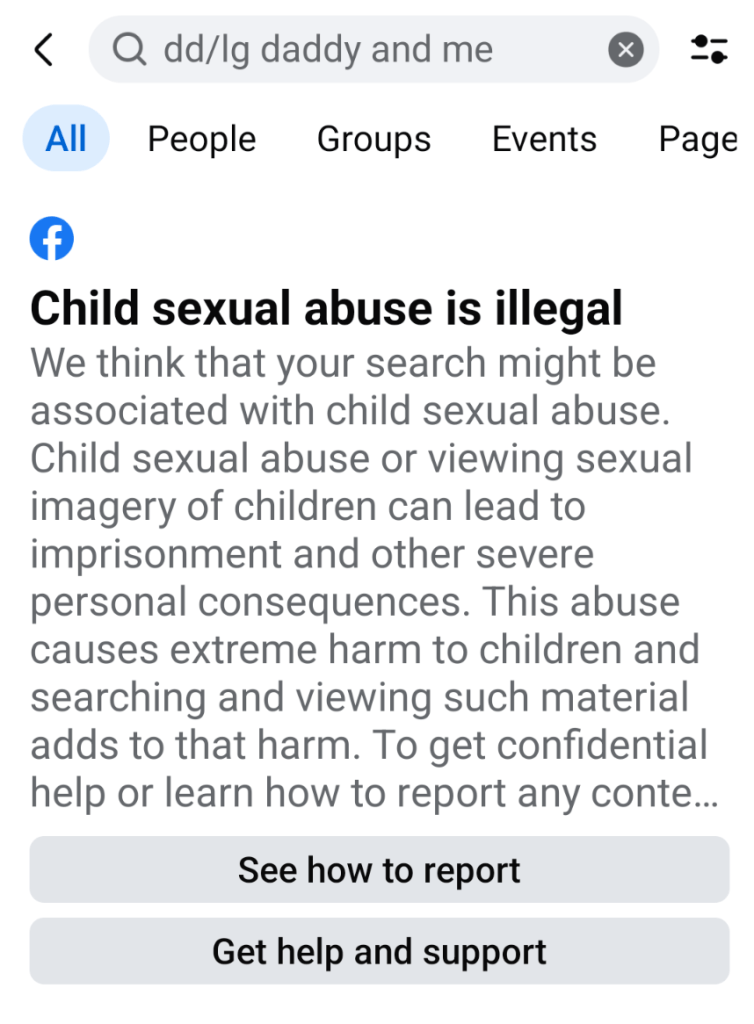
Searching “DD/LG Daddy and Me” on Facebook no longer returned the group. Instead, Facebook served this:
“Child sexual abuse is illegal. We think that your search might be associated with child sexual abuse.”
The group that had been publicly visible, publicly searchable, and publicly growing, 2,600 members, 492 new in the last week, 7 posts that morning alone, was gone from search results. Still visible in recent search history. Gone from active results.
Let me be clear about what that means.
Facebook’s own system now flags the search term “DD/LG Daddy and Me” with a warning associated with child sexual abuse. Their own warning. Their own words.
And yet that same system allowed the group to run publicly for eight years.
It took a journalist posting a teaser on a Friday morning for something to shift. Not eight years of operation. Not 2,600 members. Not 492 people joining in a single week. Not men queuing in comment threads to DM an 18-year-old who had just announced her little age was 1-3.
A Facebook post. On a Friday. Before 11am.
But here is what did not change.
Other DD/LG groups remain publicly visible and findable on Facebook right now. The architecture is intact. The ecosystem is untouched. One door quietly closed, possibly reported, possibly the admins went private when the teaser landed, possibly Facebook’s systems finally stirred after eight years.
The rest of the doors are still open.
This is not moderation. This is damage control. And damage control is only necessary when someone is paying attention.
I’m paying attention.
All screenshots documenting the group, its public status, member count, growth figures, posts, and comment threads, were captured and preserved before publication. The evidence exists. The group’s disappearance does not change what was there. It confirms it.

 The Grooming Files
Leave a comment