
THE GROOMING FILES | INVESTIGATIVE ANALYSIS
©️ Sophie Lewis | Journalist | The Grooming Files
Why Power Corrupts And Why Elite Abuse Is Structural, Not Accidental
A Structural Analysis of Power-Dominant Offending and Systemic Safeguarding Failure

IMPORTANT NOTE: This essay presents structural and psychological analysis of documented patterns in elite abuse. It does not make accusations against unnamed individuals. All case references are limited to court-established facts from the prosecutions of Jeffrey Epstein and Ghislaine Maxwell. The author’s contrasting typology, the Exposure Spiral, is drawn from the author’s own documented primary research.
The Question We Keep Asking Wrong
Every time a high-status figure is exposed in a child abuse scandal, the public reaction follows the same script.
Shock. Disgust. Outrage. Then confusion.
“How could someone with everything risk it all?”
That question reveals a fundamental misunderstanding.
They are not risking everything.
That is the point.
This essay argues that elite child sexual abuse is not a psychological aberration that happens to occur among the powerful. It is, in significant part, a structural phenomenon shaped, enabled, and sustained by the architecture of power itself. To understand it only through the lens of individual pathology is to misread the crime and guarantee its continuation.
This is not a claim that all powerful people are offenders, that wealth creates paedophilia, or that specific unnamed individuals are guilty of anything. It is a structural and psychological analysis of the documented mechanisms that allow certain individuals, in certain environments, to cause catastrophic harm whilst systems look elsewhere.
Two Architectures
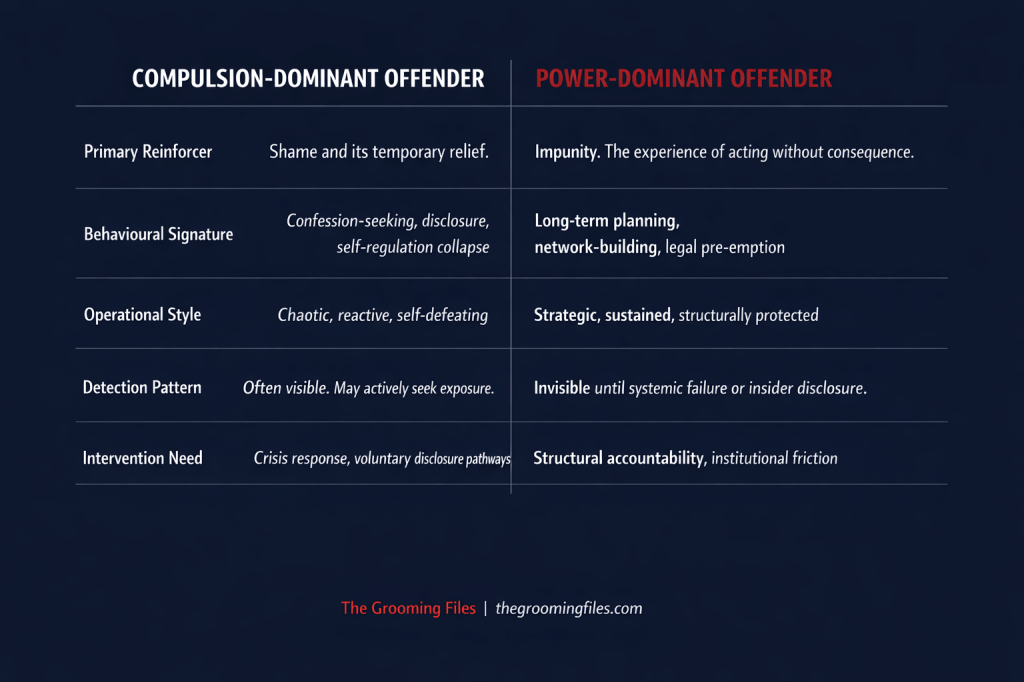
The author’s prior research into what has been termed the Exposure Spiral, a behavioural typology documented through direct engagement with three self-confessing offenders, identified a compulsion-dominant offender architecture characterised by shame-arousal cycles, failed self-regulation, and compulsive disclosure.
Those offenders sought exposure. They messaged a survivor-journalist voluntarily. They begged to be watched, monitored, contained. One said plainly: “I don’t trust myself.” Their shame was not a deterrent. It was the fuel.
What the Epstein prosecution revealed is something categorically different.
Not chaotic compulsion. Not shame spiralling into confession. But long-term operational planning, network orchestration, legal pre-emption, and the strategic cultivation of insulation. Ghislaine Maxwell’s 2021 conviction for child sex trafficking established that this was an enterprise, with recruiters, a hierarchy, structured locations, and deliberate victim selection targeting the most vulnerable and least credible.
That is not dysregulation. That is architecture.
COMPULSION-DOMINANT OFFENDER
Primary reinforcer: Shame and its temporary relief through exposure
Behavioural signature: Confession-seeking, disclosure, collapse of self-regulation
Operational style: Chaotic, reactive, self-defeating
Detection: Often visible. Fails to hide. May actively seek exposure.
POWER-DOMINANT OFFENDER
Primary reinforcer: Impunity. The experience of acting without consequence.
Behavioural signature: Long-term planning, network-building, legal management
Operational style: Strategic, sustained, structurally protected
Detection: Often invisible until systemic failure or insider disclosure.
Same harm to victims. Fundamentally different internal and operational architecture. Different detection requirements. Different intervention needs. Current safeguarding frameworks treat child sexual exploitation as a unified phenomenon. The evidence suggests it is not.
Power Rewires Perception
Decades of behavioural research demonstrate that sustained power measurably alters cognition. Keltner’s power research established what he calls the “power paradox”, that the social intelligence and empathy which allow people to accrue power are systematically degraded by that power once held. High-status individuals consistently demonstrate reduced empathy accuracy, increased impulsivity and risk tolerance, heightened entitlement, and greater objectification of others.
Power narrows perspective. It lowers inhibition. It weakens sensitivity to social correction.
In practical terms, the more insulated someone becomes, the less real other people feel.
Children, within that hierarchy, represent the most extreme power imbalance possible. No institutional leverage. No credibility in the eyes of powerful gatekeepers. No capacity for legal retaliation. For certain personality structures, specifically those for whom dominance is a primary psychological organiser, that asymmetry is not incidental to the attraction.
It is the attraction.
This Is Not About Wealth It Is About Impunity
Wealth alone does not create predatory behaviour. This must be stated clearly.
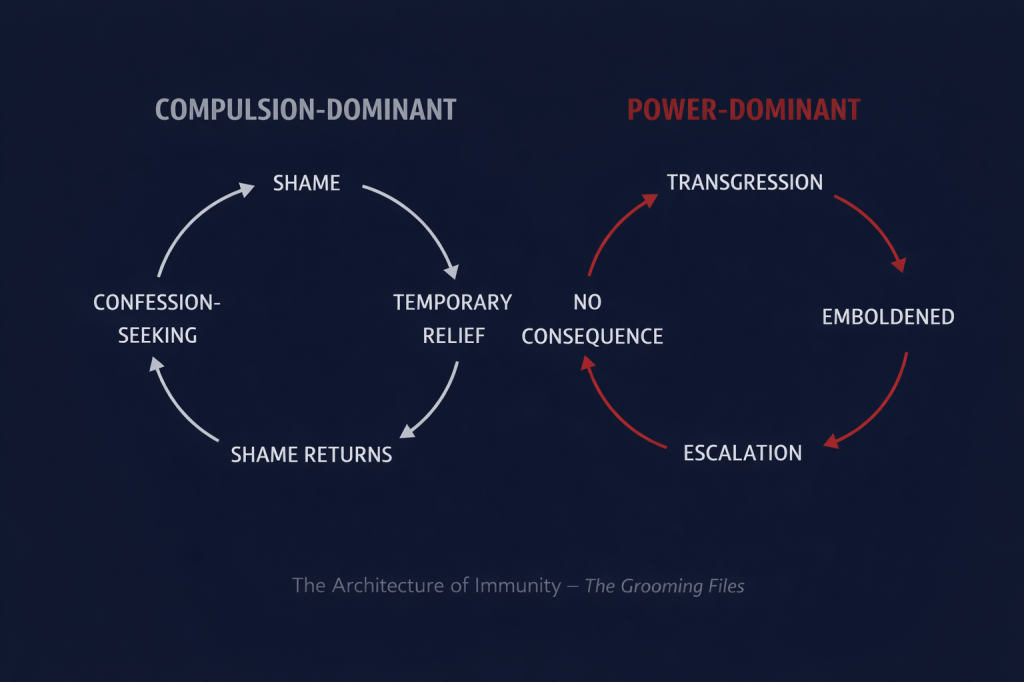
But insulation enables behaviour that would otherwise be checked. Criminology has long established that certainty of punishment deters behaviour more effectively than severity. When an individual comes to believe, through repeated experience, that consequences are unlikely, the internal inhibitory brake weakens. Not suddenly. Gradually. Through the accumulation of small unchallenged transgressions.
At elite levels, individuals frequently experience:
Legal negotiation instead of prosecution
Reputation management instead of exposure
Financial settlement instead of trial
Institutional deference instead of challenge
Social networks that absorb and contain scandal
Over time, this produces psychological drift. The boundary moves. The risk calculus recalibrates. Escalation becomes imaginable. The person is no longer operating within the same moral environment as those who face genuine consequences.
The reinforcement loop is not shame seeking temporary relief, as documented in the Exposure Spiral typology. It is the opposite. The reinforcement is the experience of acting and surviving intact. Of transgression without consequence.
Impunity is not the backdrop. It is the drug.
When power removes friction, exploitation becomes predictable.
Elite Abuse Is Networked
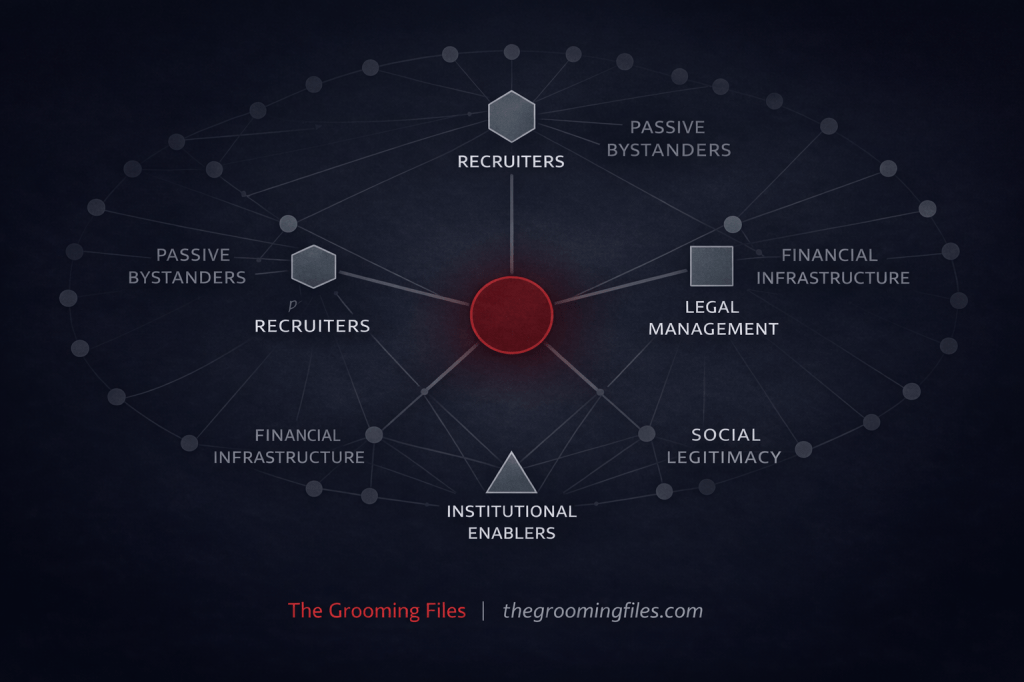
When the case against Jeffrey Epstein and Ghislaine Maxwell surfaced, what shocked people was not merely the abuse. It was the ecosystem.
Maxwell’s 2021 conviction, on five counts including sex trafficking of a minor, established through court evidence that Epstein’s operation included active recruiters, structured locations across multiple jurisdictions, deliberate targeting of economically vulnerable girls, and a supporting infrastructure of staff and associates. This was not one individual acting in isolation. It was organised.
Networks do three things that individual offending does not:
Normalise deviance within the closed group
Diffuse responsibility
Create mutual vulnerability
This is not ritual mythology. This is structural self-protection among those with shared liability.
Selection Bias at the Top
There is a second structural mechanism that demands acknowledgment, uncomfortable as it is.
Positions of extreme power tend to attract and reward specific traits. Research on dark triad characteristics, narcissism, Machiavellianism, and psychopathy, consistently shows elevated prevalence in leadership and high-status positions across sectors. Grandiosity, charm, risk tolerance, strategic manipulation, and reduced empathic response are traits that institutional selection processes frequently reward, not penalise.
Not all powerful people carry these traits. The majority do not.
But when high entitlement combines with low empathy, strategic sophistication, and environmental insulation from consequence, moral boundaries become negotiable in ways they do not for those who face ordinary accountability. The system does not create predators. But certain systems disproportionately elevate individuals for whom predatory behaviour is already a latent possibility, and then systematically remove the friction that might prevent it.
The Domination Dynamic
In many documented elite abuse cases, the central psychological driver appears to be domination rather than paraphilic attraction alone.
Children represent, within a hierarchy organised around control, the most absolute asymmetry available. Total dependency. Zero institutional power. No capacity for credible retaliation. For individuals whose sense of identity is constructed around the exercise of dominance, that asymmetry can become the point itself.
The act becomes proof of supremacy. Proof that the ordinary rules of consequence do not apply. Proof that hierarchy is not merely symbolic but real and exercisable.
The sexual element exists. But in the power-dominant architecture, the structural element may be primary, and the distinction matters enormously for how we design detection and intervention.
Institutional Protection Is About Stability
People frequently assume that when institutions protect high-status figures, the protection reflects endorsement of the behaviour. This misreads the dynamic.
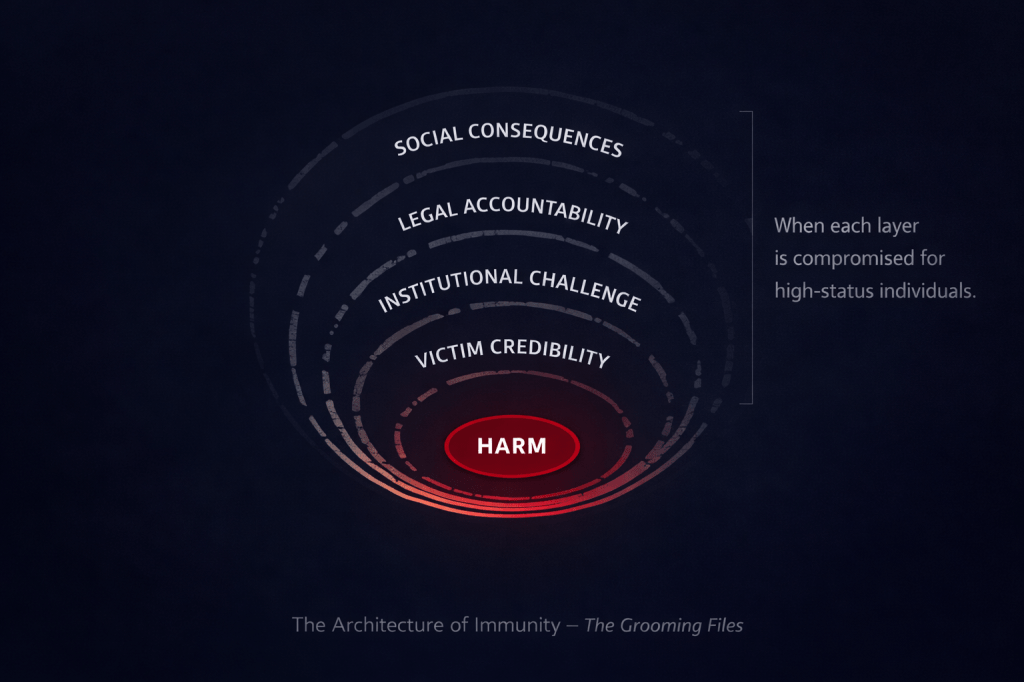
Institutions protect high-status figures because scandal destabilises. Financial exposure. Reputational collapse. Questions about internal governance that could unravel careers and legitimacy far beyond the individual case. Containment is not endorsement. It is, in most cases, institutional self-preservation framed internally as pragmatism.
Sometimes that containment crosses into active complicity.
Often it manifests as cowardice dressed up as procedure. A failure to ask questions whose answers would require action. A preference for managed silence over disruptive truth.
But the outcome is identical: immunity, reinforced.
The Psychological Moment of Untouchability
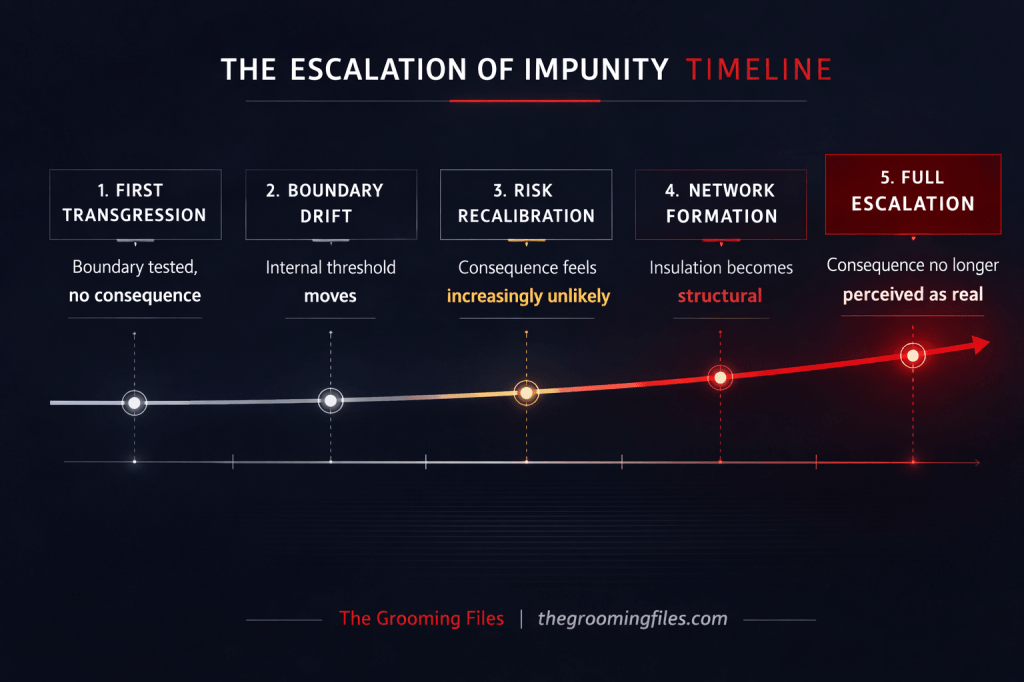
There is a threshold in prolonged power, not a dramatic crossing, but a gradual drift, where consequence stops feeling real.
When someone is rarely challenged, socially shielded, legally buffered, and surrounded by deference, their internal moral compass loses its external calibration. Right and wrong are no longer negotiated against social reality. They become privately determined. Self-referential. Detached from the experience of those they affect.
This is the moment the environment produces the full danger. Not because the person has suddenly become monstrous.
Because the environment has removed resistance.
Why The Pattern Repeats
This is not new. Across monarchies, colonial administrations, corporate oligarchies, religious institutions, and authoritarian regimes, those holding unchecked authority have repeatedly exploited those beneath them. The specific nature of the harm varies. The structural formula does not.
Hierarchy without friction erodes restraint. Reduced accountability increases the perceived viability of transgression. Transgression plus entitlement plus insulation produces harm. The formula is historically consistent.
What changes across eras is not human nature. It is the presence or absence of mechanisms designed to introduce friction, accountability structures, independent oversight, whistleblower protection, transparent legal processes, that prevent the gradual drift toward impunity.
The Hardest Truth
The scandal is not that powerful individuals commit abuse.
The scandal is that systems are structured in ways that allow certain personality types to rise, consolidate power, operate with reduced friction, and harm people whose vulnerability makes credible complaint structurally difficult.
The Epstein prosecution did not expose a lone monster. It exposed a machine. Maxwell’s conviction confirmed that the machine had parts, a hierarchy, operational continuity, and a social context that chose, repeatedly, not to intervene.
The machine is the subject of this analysis. Not the monsters. The machine.
The Right Question
The question we should stop asking:
“Why are elites paedophiles?”
The question we must start asking:
“What mechanisms allow extreme power to operate without meaningful accountability, and who benefits from their absence?”
Because until that question is addressed structurally, legally, culturally, institutionally, exposure will always be reactive. A name will surface. Public outrage will spike. The news cycle will move on. Another figure will eventually fall.
And the architecture will remain intact.
The question is not whether powerful men can harm.
The question is whether our systems are designed to stop them.
What This Demands
This analysis generates four demands, not as recommendations to be considered, but as logical conclusions from the evidence:
Safeguarding frameworks must distinguish between compulsion-dominant and power-dominant offending, because they are not the same phenomenon, do not present the same way, and cannot be addressed with the same interventions.
Institutional accountability structures must be designed specifically to resist the gravitational pull of high-status protection, because the default institutional response to powerful-figure risk is containment, not action.
Victim credibility frameworks must be restructured, because the systematic targeting of vulnerable, low-credibility victims is not incidental to elite abuse but intrinsic to the power-dominant architecture.
Academic research must formally recognise the power-dominant offender as a distinct criminological category, because what cannot be named cannot be systematically addressed.
These are not abstract demands. They are the logical consequence of taking seriously what the Maxwell conviction and the Exposure Spiral research, taken together, reveal:
Child sexual exploitation is not one thing. It is at least two. And we have been designing responses to both as though they were one.
Sophie Lewis
Survivor | NUJ-Accredited Journalist | Criminology Researcher
The Grooming Files | thegroomingfiles.com
This essay is part of an ongoing investigative and academic research programme into predator typology and systemic safeguarding failure. The author’s prior work establishing the Exposure Spiral typology is available at thegroomingfiles.com.

 The Grooming Files
Leave a comment