
©️ Sophie Lewis|The Grooming Files
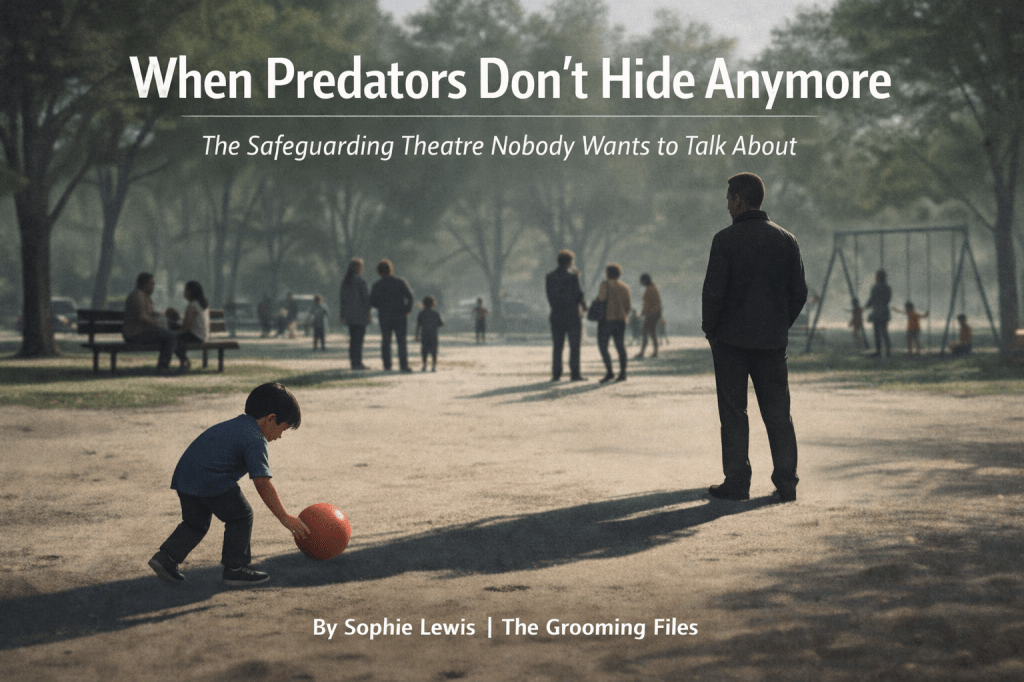
The Safeguarding Theatre Nobody Wants to Talk About
We’ve been trained to look for monsters in the shadows.
Hooded figures. Dark alleys. Secret networks. Encrypted chats.
The idea that predators hide is comforting, because it reassures us that if we just stay alert enough, vigilant enough, we’ll spot them.
But that belief is now dangerously out of date.
Some of the most concerning predatory behaviours I’ve observed in recent years haven’t happened in secret at all. They’ve happened in plain sight. In families. In community spaces. In online groups. In professional settings. In rooms where safeguarding policies are printed, framed, and proudly displayed on the wall.
This isn’t a failure of vigilance.
It’s a failure of recognition.
The Myth of the Hidden Predator
Safeguarding training still relies heavily on an outdated model: the predator as covert, deceptive, lurking.
That model doesn’t account for what many survivors and observers are seeing now. A shift where certain individuals no longer rely on secrecy, but instead operate under a cloak of normality, status, or perceived harmlessness.
They don’t hide.
They blend.
They’re the ones who are “always around to help.”
The ones who are “great with kids.”
The ones whose behaviour raises quiet alarms, but never quite enough to trigger formal action.
And that’s the problem.
Behaviour That Gets Dismissed Until It’s Too Late
There are behaviours that make people uncomfortable, but not enough to be taken seriously.
Lingering attention.
Eyes that track children a second too long.
Physical proximity that feels unnecessary.
Touch that’s technically “innocent” but contextually wrong.
A sudden shift in energy when a child enters a space.
These things are often explained away as coincidence, awkwardness, or misinterpretation.
“He didn’t mean it like that.”
“You’re reading too much into it.”
“They’d never do something like that.”
Picture the youth worker who always volunteers to drive lone children home. Who finds reasons to be alone with one child in particular. Who texts them outside group activities. Who buys them small gifts. Who everyone describes as “just really dedicated.”
Each behaviour, isolated, is explainable. Together, they’re a grooming pattern.
But the system won’t see it until a disclosure occurs.
Safeguarding systems are built to respond to evidence, not instinct.
But predatory behaviour often lives in the space before evidence exists.
That grey zone is where harm is incubated.
Why Institutions Choose Not to See This
Institutions are structurally bad at responding to patterns without incidents.
They prefer:
- Clear disclosures
- Legal thresholds
- Documented offences
- Procedural certainty
What they struggle with is cumulative unease. The slow build-up of warning signs that never quite cross the line individually, but scream danger when viewed together.
And so the system waits.
It waits for escalation.
It waits for proof.
It waits for a child to speak, often after harm has already occurred.
Institutions prefer clear incidents because incidents have closure. Patterns require ongoing vigilance, resources, and accountability. That’s expensive. That’s uncomfortable. So they wait.
This isn’t neutrality.
It’s negligence dressed up as caution.
The Cost of Doubting Instinct
Survivors know this pattern intimately.
Many of us remember adults who almost noticed.
Adults who felt something was off but didn’t act.
Adults who deferred to politeness, hierarchy, or fear of being wrong.
The truth is brutal but necessary to say:
Most abuse is not missed because it is invisible.
It is missed because acknowledging it would require disruption.
Disrupting families.
Disrupting institutions.
Disrupting reputations.
Disrupting the illusion that “this doesn’t happen here.”
So instead, the discomfort is silenced.
Safeguarding Has Become Performative
We now live in an era of safeguarding theatre.
Policies exist.
Training is mandatory.
Posters are displayed.
Statements are issued.
But when it comes to responding to early warning signs, the system freezes.
Because real safeguarding isn’t tidy.
It isn’t comfortable.
And it often means acting before certainty.
That’s the part nobody wants to fund, lead, or be responsible for.
A Shift We Can’t Ignore
What’s emerging now is not just individual predatory behaviour, but a systemic blind spot.
A refusal to accept that some people:
- Don’t escalate quickly
- Don’t rely on secrecy
- Don’t fit the stereotype
- Test boundaries slowly, socially, psychologically
These individuals exploit social trust, not darkness.
And until safeguarding frameworks adapt to that reality, they will continue to fail the very people they claim to protect.
Listening Before Proof Exists
This isn’t a call for witch-hunts or paranoia.
It’s a call for:
- Taking behavioural patterns seriously
- Valuing survivor-informed insight
- Trusting discomfort as data
- Intervening earlier, not later
Safeguarding should not begin at disclosure.
It should begin at recognition.
If your system only works once a child has been harmed, it is not a safeguarding system.
It’s a damage-control mechanism.
And children deserve better than that.
Sophie Lewis is an NUJ-accredited journalist and founder of The Grooming Files, a survivor-led investigative platform documenting predator behaviour and systemic safeguarding failures. Her book, The Exposure Spiral: When Predators Beg to Be Stopped And The System Does Nothing, is available now.

 The Grooming Files
Leave a comment