
©️ By Sophie Lewis | The Grooming Files
Why Some Predators Turn to Dommes and What That Says About a System That’s Already Failed
There’s a pattern most people don’t want to talk about.
Not because it’s rare.
But because it’s deeply uncomfortable.
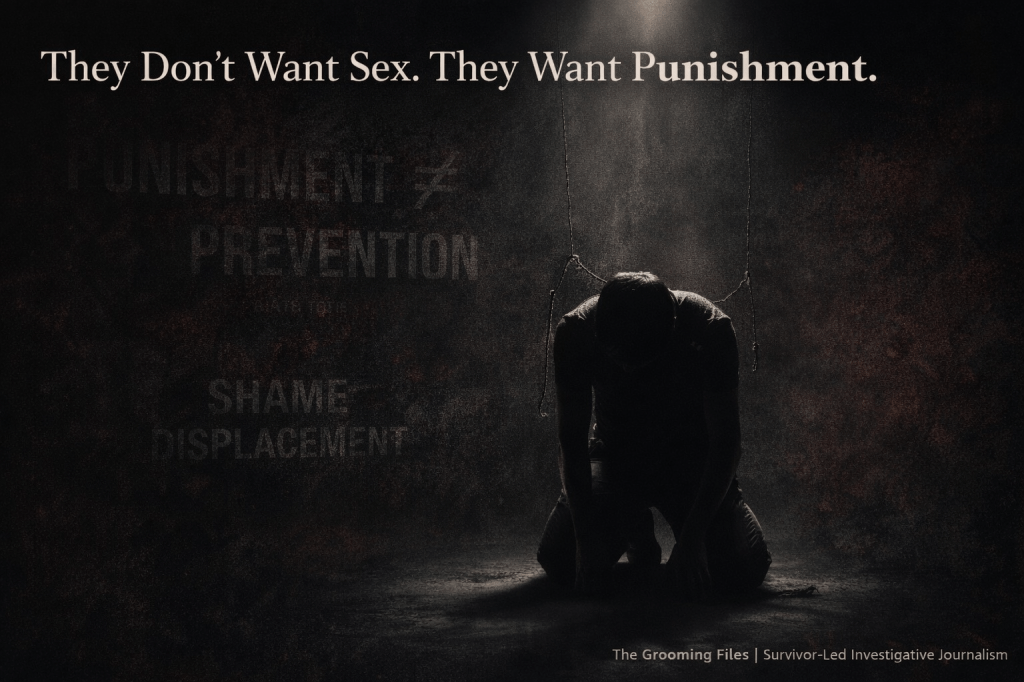
Some predators, including men who openly admit to being a risk, have been documented seeking out Dommes not for pleasure, but for punishment.
Not fantasy.
Not indulgence.
Punishment.
This isn’t about kink culture.
It’s about what happens when systems abandon risk before it turns into harm.
The Misunderstanding That Keeps Everyone Safer Except Children
The public narrative goes like this:
Predators are driven by desire.
Domination is erotic.
Punishment is sexual.
That framing is dangerously simplistic.
What I’ve encountered repeatedly is something else entirely. Men who are flooded with intrusive thoughts, shame, and fear of their own impulses, actively seeking someone else to control them.
They don’t trust themselves.
They don’t feel safe alone with their own minds.
And they have nowhere legitimate to turn.
So they go underground.
This Is Not About Arousal. It’s About Regulation.
When these men approach Dommes, what they are often seeking is:
• external control
• enforced rules
• humiliation as containment
• punishment as relief
Punishment becomes a crude form of nervous system regulation.
It temporarily lowers internal pressure.
It quietens intrusive thoughts.
It creates the illusion that something has been “paid for”.
For a moment, they feel contained.
This mirrors what trauma research describes as externalised regulation under chronic shame.
And that should terrify us.
Because punishment is not accountability.
And relief is not prevention.
Shame Displacement: Outsourcing the Unbearable
Many offenders, or would-be offenders, cannot tolerate their own shame internally.
So they displace it.
They hand it to someone else and say:
Hold this. Control me. Hurt me. Tell me what I am.
A Domme becomes:
• confessor
• judge
• punisher
• substitute authority
This is not power play.
It is shame outsourcing.
And it only works for as long as someone else is holding the weight.
Pseudo-Accountability: “If I’m Punished, I’m Managing the Risk”
Here is the most dangerous belief I see:
That suffering equals responsibility.
As long as they are:
• humiliated
• financially punished
• verbally degraded
• controlled
They believe they are doing something about the danger they pose.
They are not.
There is no monitoring.
No safeguarding framework.
No escalation protocol.
No victim protection.
Just a private loop of pressure and release.
Which always resets.
Why This Is a Safeguarding Failure, Not a Kink Issue
Let’s be very clear.
Dommes are not clinicians.
They are not regulators.
They are not trained safeguarding professionals.
And they should never be positioned, or forced by systemic absence, into becoming one.
The fact that predators are turning to fetish spaces for containment tells us something vital.
There is no accessible, non-punitive, early-intervention pathway for people experiencing dangerous intrusive thoughts, whether they have offended before or are desperately trying not to.
We have built systems that only respond after harm.
And then we act shocked when harm occurs.
The Question No Institution Wants to Answer
Why is the only place some high-risk individuals feel able to disclose their thoughts underground?
Why does “tell someone” lead to:
• instant criminalisation
• total social annihilation
• or silence
Why are we surprised when secrecy escalates risk?
This is not sympathy.
It is reality.
And ignoring it does not protect children.
It protects denial.
The Uncomfortable Truth
When men seek punishment, they are telling us something.
They are telling us:
• they know they are a risk
• they feel out of control
• they are terrified of themselves
• and the system has nothing for them except consequences after harm
That is not prevention.
That is delayed disaster.
Where The Grooming Files Stands
This work is not about normalising offenders.
It is about exposing the gaps that allow harm to grow in the dark.
Survivor-led journalism does not mean silence.
It means naming what others refuse to look at.
Because safeguarding that only reacts is not safeguarding at all.
It is abandonment with better PR.
This is what I’ve been documenting.
This is what the degree work sharpened.
This is what happens when you actually sit in the room and ask the questions no one else will.
If the systems won’t look, we will.
Sophie Lewis is an NUJ-accredited journalist, final-year BA (Hons) Social Sciences student specialising in criminology, and founder of The Grooming Files.

 The Grooming Files
Leave a comment