
©️ Sophie Lewis|The Grooming Files
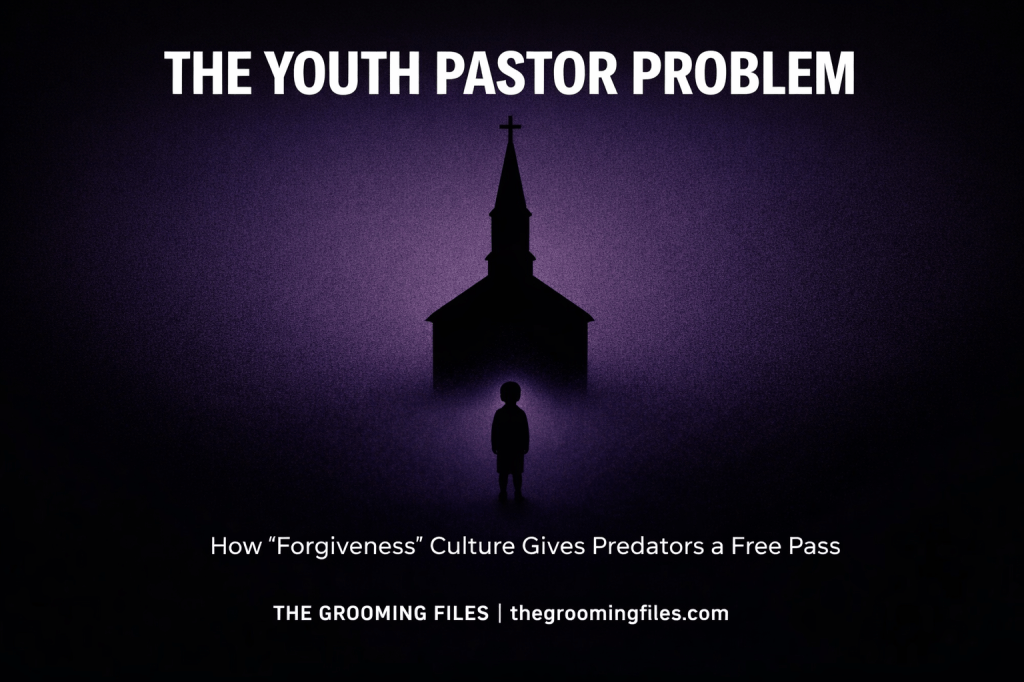
Every few months, another one hits the headlines.
Youth pastor arrested. Assistant minister charged. Worship leader convicted.
And every time, the same shocked responses: “He seemed so godly.” “The children loved him.” “He was so good with the youth group.”
Of course he was. That’s the entire bloody point.
Let me show you what churches don’t want you to see: a systematic pattern of institutional grooming, predator protection, and victim silencing that operates under the cover of “Christian forgiveness.”
This isn’t about faith. This is about power. And churches are handing predators the keys to the kingdom whilst calling it ministry.
WHY YOUTH MINISTRY IS A PREDATOR MAGNET
Let’s start with the uncomfortable truth: youth ministry creates the perfect hunting ground.
Unfettered Access:
- One on one “mentorship” sessions
- Overnight trips and retreats
- Church camps with minimal supervision
- Youth group meetings in homes or church buildings after hours
- “Discipleship” relationships that isolate teens from parents
Built In Trust:
- Religious authority positioned as divine
- “Man of God” status creates unquestionable credibility
- Parents actively encouraged to trust youth leaders with their children
- Spiritual guidance blurs boundaries between appropriate and inappropriate
Emotional Vulnerability:
- Teens are questioning identity, faith, sexuality, purpose
- Youth ministry explicitly targets emotional openness
- “Safe space” rhetoric creates false security
- Confession culture normalises sharing intimate details
Minimal Oversight:
- Volunteer positions with inadequate vetting
- No professional training requirements
- Church governance protecting reputation over children
- Insular communities resistant to external accountability
Put it together and you’ve got a predator’s dream: vulnerable children, minimal supervision, maximum authority, and a community programmed to protect the institution.
THE GROOMING PLAYBOOK: FAITH EDITION
Youth pastor grooming follows a predictable pattern. Here’s what it actually looks like:
STAGE ONE: THE SPIRITUAL MENTOR
The predator positions himself as uniquely equipped to guide the child’s faith journey.
What it looks like:
- “God has called me to mentor you specifically”
- Extra attention framed as spiritual investment
- Private prayer sessions or Bible studies
- Becoming the teen’s “spiritual covering” or authority figure
- Creating dependency: “You can tell me things you can’t tell your parents”
Why it works: Religious framing makes the attention feel sacred, not suspicious. Parents are grateful someone is “investing in their child’s faith.”
STAGE TWO: THE SPECIAL RELATIONSHIP
Boundaries dissolve under the guise of spiritual intimacy.
What it looks like:
- Late night texts about “spiritual struggles”
- Physical affection normalised as “Christian love”
- Sharing personal struggles to create false equality
- “God brought us together” rhetoric
- Isolation from peers: “They wouldn’t understand our connection”
Why it works: The relationship is framed as divinely ordained. Questioning it becomes questioning God.
STAGE THREE: THE SEXUALISATION
Sexual content is introduced gradually, wrapped in religious language.
What it looks like:
- Conversations about sexual purity that become graphic
- “Accountability” questions about masturbation, fantasies, bodies
- Physical boundaries tested: longer hugs, touching during prayer
- Sexual content framed as “education” or “helping you stay pure”
- Victim blamed for “tempting” the leader with their body/behaviour
Why it works: Purity culture already sexualises children’s bodies. Predators exploit this by positioning themselves as the ones helping the teen “resist temptation.”
STAGE FOUR: THE ABUSE
When abuse occurs, it’s reframed as mutual sin or the victim’s fault.
What it looks like:
- “We both sinned” (NO. An adult abused a child)
- “You tempted me” (NO. Predators choose to offend)
- “God will forgive us if we repent” (Abuse isn’t a sin to repent, it’s a crime)
- “This is our secret covenant with God”
- Threats of exposure framed as spiritual consequences
Why it works: The victim is trapped between abuse and spiritual damnation. Reporting becomes “destroying a man of God’s ministry.”
HOW CHURCHES PROTECT PREDATORS
When abuse is disclosed, churches follow a devastatingly predictable script:
STEP ONE: DENY AND DEFLECT
The Church Response:
- “We take these allegations very seriously” (translation: we’re going to do nothing)
- “We’re investigating internally” (translation: we’re covering it up)
- “He’s stepped down from ministry to focus on his family” (translation: we’re protecting him)
- “We found no evidence of misconduct” (translation: we didn’t look)
What Actually Happens:
The predator is quietly moved to another congregation. No police report. No safeguarding notification. No warning to the new church.
STEP TWO: BLAME THE VICTIM
The Victim Hears:
- “What were you wearing?”
- “Did you encourage him?”
- “Why were you alone with him?”
- “He’s a godly man, you must be mistaken”
- “You’re destroying his ministry with these lies”
- “Forgiveness means not pressing charges”
What This Does:
Isolates the victim. Protects the predator. Ensures future victims won’t report.
STEP THREE: WEAPONISE FORGIVENESS
The Church Preaches:
- “We’re all sinners”
- “He’s repented, we must forgive”
- “Judgment belongs to God, not the courts”
- “Pressing charges isn’t the Christian way”
- “Restoration, not punishment”
What This Means:
The predator faces no consequences. The victim is pressured to “forgive and forget.” The church protects its reputation whilst calling it grace.
STEP FOUR: SILENCE AND SHUN
If the Victim Persists:
- They’re accused of being “divisive”
- “Not walking in forgiveness”
- “Used by Satan to attack the church”
- Ostracised from the community
- Their family pressured to leave
Meanwhile the Predator:
- Remains in leadership or moves to another church
- His “restoration journey” is celebrated
- Victim is never mentioned again
- Pattern continues unchecked
THE DOCTRINE THAT ENABLES ABUSE
Certain theological beliefs create perfect conditions for predator protection:
“JUDGE NOT”
Used to silence anyone questioning leadership behaviour. Accountability becomes “judgment.” Reporting becomes “gossip.”
“TOUCH NOT GOD’S ANOINTED”
Leaders are positioned as untouchable. Challenging them is challenging God. This doctrine has protected countless predators.
“FORGIVE SEVENTY TIMES SEVEN”
Victims are pressured to forgive repeatedly. Consequences for predators are framed as “unforgiving.” Abuse becomes a “mistake” requiring grace, not a crime requiring justice.
“SUBMIT TO AUTHORITY”
Children and teens are taught absolute submission to spiritual authority. Predators exploit this by positioning themselves as God’s representatives.
“MODESTY CULTURE”
Girls are taught their bodies cause men to stumble. When abuse occurs, the victim is blamed for “tempting” the predator. This shifts responsibility from offender to victim.
“BIBLICAL COUNSELLING ONLY”
Professional therapy is discouraged. Internal church counselling keeps abuse hidden. No mandatory reporting. No external accountability.
REAL CASES, REAL PATTERNS
Let me give you some examples. These aren’t hypotheticals. These are documented cases:
Case One: The Moved Minister
Youth pastor in Texas sexually abused multiple teen girls. Church “investigated internally,” found him “repentant,” moved him to a church in Florida. He reoffended within six months. No police report from first church. No warning to second church.
Case Two: The Restored Rapist
Worship leader convicted of sexual assault of a minor. Served two years. Released and immediately restored to volunteer position in children’s ministry at his home church because “he’s done his time and repented.”
Case Three: The Forgiven Offender
Assistant pastor groomed and abused 14 year old girl over two years. When she disclosed, church leadership told her family that pressing charges would “destroy his ministry and marriage.” She was pressured to participate in “reconciliation meetings” with her abuser. He remained in ministry. She left the church.
Case Four: The Protected Predator
Senior pastor sexually abused children for over a decade. Multiple families reported to church leadership. Leadership covered it up, moved families to different services, paid settlements with NDAs attached. Predator remained in position until a criminal investigation forced removal.
These aren’t outliers. This is the pattern.
WHY THIS KEEPS HAPPENING
Churches protect predators for the same reasons all institutions do:
Reputation Protection:
A sexual abuse scandal damages the church’s standing in the community. Protecting reputation becomes more important than protecting children.
Financial Concerns:
Abuse disclosures lead to lawsuits, insurance issues, decreased attendance, reduced tithing. Silence is cheaper than accountability.
Leadership Loyalty:
Church leaders protect each other. Admitting one leader is a predator raises questions about oversight, vetting, and other leaders.
Theological Justification:
“Forgiveness” and “restoration” provide religious cover for institutional failure. Protecting a predator becomes reframed as “Christlike grace.”
Insular Culture:
Churches operate as closed communities. External accountability (police, social services) is seen as worldly interference. Internal handling keeps abuse hidden.
Power Dynamics:
Church leadership holds spiritual authority over congregants. Challenging this authority means risking community, identity, and sometimes family relationships.
WHAT CHURCHES SHOULD DO (BUT WON’T)
Here’s what actual safeguarding looks like:
1. Mandatory Reporting to Police:
Any disclosure of abuse goes to police immediately. No internal investigation. No “handling it biblically.” Straight to authorities.
2. Zero Tolerance Policy:
Any leader credibly accused of abuse is permanently removed from all ministry positions. No restoration to leadership. Ever.
3. External Oversight:
Independent safeguarding audits. External organisations monitoring church policies and responses. No self policing.
4. Comprehensive Vetting:
Background checks, reference checks, safeguarding training for ALL volunteers and staff working with children and youth.
5. Structural Safeguards:
- No one on one meetings between adults and minors
- Open door policies
- Multiple leaders present at all youth activities
- Parents informed of all communication and activities
- Clear boundaries around physical contact
6. Survivor Centred Response:
When abuse is disclosed, the victim is believed, supported, and connected with professional trauma services. The focus is their healing, not the institution’s reputation.
7. Theological Accountability:
Teaching that challenges harmful doctrines. “Forgiveness” doesn’t mean no consequences. “Grace” doesn’t mean no accountability. “Restoration” doesn’t mean returning to leadership.
Most churches will do none of this. Because it would require admitting the problem is systemic, not isolated.
WHAT PARENTS NEED TO KNOW
If your child is involved in youth ministry, ask these questions:
About Policies:
- What is your safeguarding policy?
- Who conducts background checks and how thorough are they?
- What training do youth leaders receive?
- What are your protocols for one on one interactions?
- How do you handle abuse disclosures?
About Leadership:
- How long have youth leaders been in this role?
- Where did they serve previously?
- Can I speak to references from previous churches?
- What oversight exists for youth ministry?
About Activities:
- What supervision ratios are maintained?
- Are parents notified of all activities and communication?
- What are the boundaries around physical contact?
- How are private conversations handled?
Red Flags to Watch For:
- Leaders who insist on one on one time with children
- “Special relationships” between adults and specific teens
- Resistance to parental involvement or questions
- Secretive communication (private texts, social media)
- Physical affection that seems excessive
- Leaders sharing personal struggles with teens
- Isolation of certain children from the group
- Defensiveness when policies are questioned
If your church can’t answer these questions clearly or becomes defensive, that’s your answer. Remove your child.
TO SURVIVORS: I BELIEVE YOU
If you were abused by a youth pastor, minister, or church leader:
It wasn’t your fault.
You didn’t tempt him. You didn’t cause it. You weren’t “mature for your age.” An adult in a position of trust and authority abused you.
Forgiveness is not mandatory.
You don’t owe your abuser forgiveness. You don’t owe the church silence. You don’t owe anyone “Christian grace” at the expense of your healing.
Reporting is not unbiblical.
Protecting children is biblical. Justice is biblical. Accountability is biblical. The church that tells you otherwise is protecting predators, not practicing faith.
Your healing matters more than their reputation.
The church’s reputation, the predator’s ministry, his family, his future. None of that matters more than your safety and healing.
You deserved protection.
The adults around you failed. The institution failed. That failure is on them, not you.
THE BOTTOM LINE
Youth ministry culture creates perfect conditions for grooming.
Church doctrine provides cover for predator protection.
Forgiveness theology silences victims and enables reoffending.
And children pay the price whilst churches call it grace.
This isn’t about attacking faith. This is about protecting children.
Every survivor who was told to forgive their abuser deserves justice.
Every parent who trusted a “man of God” with their child deserves honesty.
Every child currently in youth ministry deserves safeguarding that actually works.
Until churches prioritise children over reputation, predators will keep preaching.
And we need to stop pretending that’s acceptable just because it’s wrapped in Scripture.
If you were abused in a religious setting:
UK:
- NAPAC (National Association for People Abused in Childhood): 0808 801 0331
- Rape Crisis: 0808 802 9999
- NSPCC: 0808 800 5000
US:
- RAINN: 1-800-656-4673
- Childhelp National Child Abuse Hotline: 1-800-422-4453
International:
- GRACE (Godly Response to Abuse in the Christian Environment): http://www.netgrace.org
Report abuse to police, not just church leadership. You deserve justice, not just “biblical counselling.”
©️ Sophie Lewis | The Grooming Files
Survivor led investigative journalism exposing what institutions refuse to see

 The Grooming Files
Leave a comment