
©️ Sophie Lewis|The Grooming Files
We’ve been sold a lie.
The lie that grooming only happens to “vulnerable” children. That it’s about dark alleyways and suspicious strangers. That once kids hit their teens, they’re “old enough to know better.”
Bollocks.
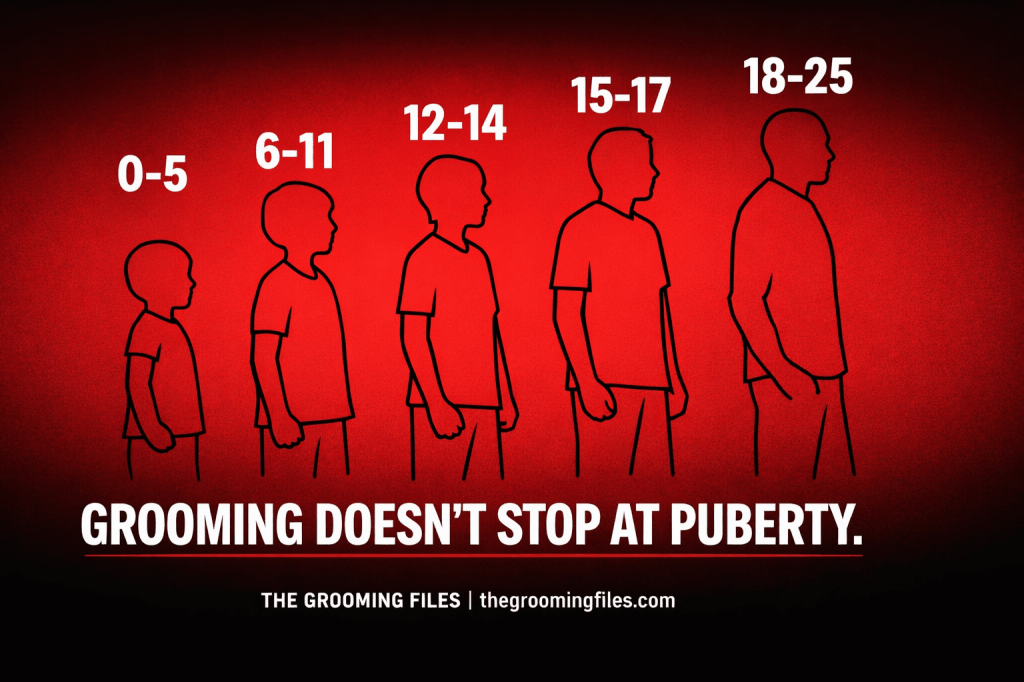
Grooming doesn’t stop at puberty. It doesn’t respect age boundaries. And it sure as hell doesn’t wait for vulnerability. It creates it.
Let me show you what grooming actually looks like across every age group. Not the sanitised version you see in school assemblies. The real thing.
EARLY CHILDHOOD (0-5): NORMALISATION
What We Think: “They’re too young to be targeted.”
The Reality: Predators normalise sexual content and boundary violations before children have language to describe what’s wrong.
What It Looks Like:
- “Tickling games” that focus on private areas
- Teaching children that adults’ bodies are “special secrets”
- Normalising nudity in contexts that aren’t appropriate
- Gradual desensitisation to sexual language or images
- Rewards for keeping secrets from other adults
Why It Works: Children this age are learning social rules. If an authority figure teaches them that certain behaviours are “normal,” they have no framework to question it.
The Damage: By the time these children can articulate what happened, the grooming is so deeply embedded they often believe they consented or that it was their fault.
PRIMARY SCHOOL AGE (6-11): THE TRUST BUILD
What We Think: “Stranger danger” talks will protect them.
The Reality: 90% of child sexual abuse is committed by someone the child knows and trusts. Your “don’t talk to strangers” script is utterly useless.
What It Looks Like:
- Adults who are “extra nice” or give special attention
- Gifts, privileges, or favouritism that create obligation
- Gradual boundary pushing disguised as “affection”
- Testing reactions to sexual content or “jokes”
- Creating situations where the child is isolated with the predator
Why It Works: Children are taught to obey adults. Predators exploit this by positioning themselves as safe, trustworthy authority figures: teachers, coaches, family friends, relatives.
The Damage: When abuse occurs, children blame themselves. “I liked the attention.” “I didn’t say no.” “I accepted the gifts.” This self blame silences them for years, sometimes forever.
EARLY ADOLESCENCE (12-14): THE IDENTITY EXPLOIT
What We Think: “They’re old enough to recognise danger.”
The Reality: This is one of the highest risk periods. Adolescents are desperately seeking identity, belonging, and validation. Exactly what predators offer.
What It Looks Like:
- Online predators posing as peers on gaming platforms, Discord, TikTok
- Adults who “understand them better than their parents”
- Sexual content framed as “education” or “maturity”
- Isolation from family presented as “independence”
- Normalisation of age gap relationships through media and grooming
Why It Works: Adolescents crave autonomy and validation. Predators exploit this by making them feel “mature,” “special,” or “chosen.” The grooming happens in spaces parents don’t monitor: Snapchat, Discord, private gaming chats.
The Damage: Victims at this age often don’t recognise abuse as abuse. They believe they were in a “relationship.” The predator convinces them they consented. This cognitive dissonance destroys them.
MID-ADOLESCENCE (15-17): THE “ALMOST ADULT” TARGET
What We Think: “They should know better by now.”
The Reality: This victim blaming rhetoric is exactly what predators rely on. These teens ARE children. Legally. Developmentally. Neurologically.
What It Looks Like:
- Predators targeting teens who are “mature for their age”
- Sexual relationships framed as “consensual” despite power imbalance
- Exploitation disguised as mentorship, opportunity, or romance
- Blackmail using sexual images the teen was manipulated into sending
- Normalisation of transactional relationships
Why It Works: Society treats these teens as “almost adults” whilst simultaneously denying them adult autonomy. Predators exploit this gap, positioning themselves as the “only one who sees them as mature.”
The Damage: These victims face the harshest judgment. “She knew what she was doing.” “He’s 16, not 6.” This social blame compounds the trauma and prevents disclosure.
YOUNG ADULTHOOD (18-25): THE FORGOTTEN VICTIMS
What We Think: “They’re adults now. It’s not grooming.”
The Reality: The brain doesn’t finish developing until 25. Young adults are still vulnerable to grooming, especially those transitioning out of care, attending university, or entering workplaces.
What It Looks Like:
- Workplace grooming by supervisors, mentors, or senior colleagues
- University lecturers exploiting power dynamics
- Predators targeting care leavers with no support network
- Financial exploitation disguised as “sugar daddy” relationships
- Sexual coercion in professional settings
Why It Works: Young adults are navigating independence without full neurological maturity. Predators exploit their inexperience, financial instability, and desire for approval.
The Damage: These victims are denied the label “grooming victim” entirely. They’re told they should have known better. But grooming doesn’t stop being grooming just because the victim turned 18.
THE TACTICS THAT WORK AT EVERY AGE
Regardless of age, predators use the same core tactics:
1. Isolate: Separate the target from protective relationships
2. Normalise: Make abuse seem normal, natural, or deserved
3. Create Dependency: Emotional, financial, or social reliance
4. Shift Blame: Make the victim believe they caused or consented to abuse
5. Silence: Threats, shame, or manipulation to prevent disclosure
The tactics adapt. The pattern doesn’t change.
WHY THIS MATTERS
Every time we say “they should have known better,” we do the predator’s work for them.
Every time we limit safeguarding conversations to young children, we abandon everyone else.
Every time we treat grooming as something that only happens to “naive” kids, we miss the systematic, calculated exploitation happening at every age.
Grooming doesn’t stop at puberty. It evolves.
And if our safeguarding doesn’t evolve with it, we’re leaving children and young adults utterly unprotected.
WHAT NEEDS TO CHANGE
1. Stop age limiting the conversation
Safeguarding education must address grooming tactics relevant to EVERY developmental stage.
2. Teach critical thinking, not stranger danger
Children and teens need to recognise manipulation tactics, regardless of who’s using them.
3. Normalise disclosure at all ages
Create environments where 5 year olds AND 25 year olds feel safe reporting abuse.
4. Recognise grooming doesn’t require “vulnerability”
Predators CREATE vulnerability. Anyone can be targeted.
5. Hold systems accountable
Schools, universities, workplaces, and online platforms must have robust safeguarding that recognises grooming at all ages.
THE BOTTOM LINE
Grooming isn’t about age. It’s about power.
And predators will exploit power imbalances at every developmental stage if we let them.
So let’s stop letting them.
Let’s stop pretending grooming only happens to young children.
Let’s stop blaming older victims for “not knowing better.”
Let’s start recognising that grooming is a pattern of calculated exploitation that adapts to every age, and our safeguarding must do the same.
Because if we only protect the “young and innocent,” we abandon everyone else.
And that’s exactly what predators are counting on.
©️ Sophie Lewis | The Grooming Files
Survivor led investigative journalism exposing what institutions refuse to see

 The Grooming Files
Leave a comment