

©️ By Sophie Lewis | The Grooming Files
On 26 December 2025, I published an investigative article examining structural failures in vigilante sting operations. The piece analysed how unregulated “paedophile hunter” groups often deploy intimidation tactics, operate without professional oversight, and prioritise performance over child protection.
Within hours, one of the subjects contacted me. Six days later, he proved my thesis by enacting every intimidation tactic I’d just documented.
I didn’t report it to police. I documented it for publication. Because this isn’t about me, it’s about the pattern.
The Original Investigation
My article, “When Protectors Mirror Predators: The Structural Failures of Vigilante Sting Operations,” examined how some hunter groups use methods that mirror predator behaviour: grooming trust, exploiting vulnerabilities, and operating in accountability-free spaces. The piece focused on documented cases, including the 2015 death of Darren Kelly following online vigilante accusations, and analysed how these operations can cause serious harm whilst claiming to protect children.
One case I covered was Sam Miller’s 2023 conviction at Newcastle Crown Court for false imprisonment. During a 14-minute Facebook livestream, Miller detained an innocent man who was subsequently held by police for 17 hours before being released without charge. Judge Clemitson described Miller as having an “unhealthy obsession” with sex offenders and an “inflated sense of his own importance,” noting the group appeared focused on “Facebook likes” rather than genuine safeguarding.
Every detail about Miller’s conviction in my article was verified against court records, Judge Clemitson’s sentencing remarks, and Northumbria Police statements. This is standard journalistic practice. What happened next was not.
The Six-Day Gap
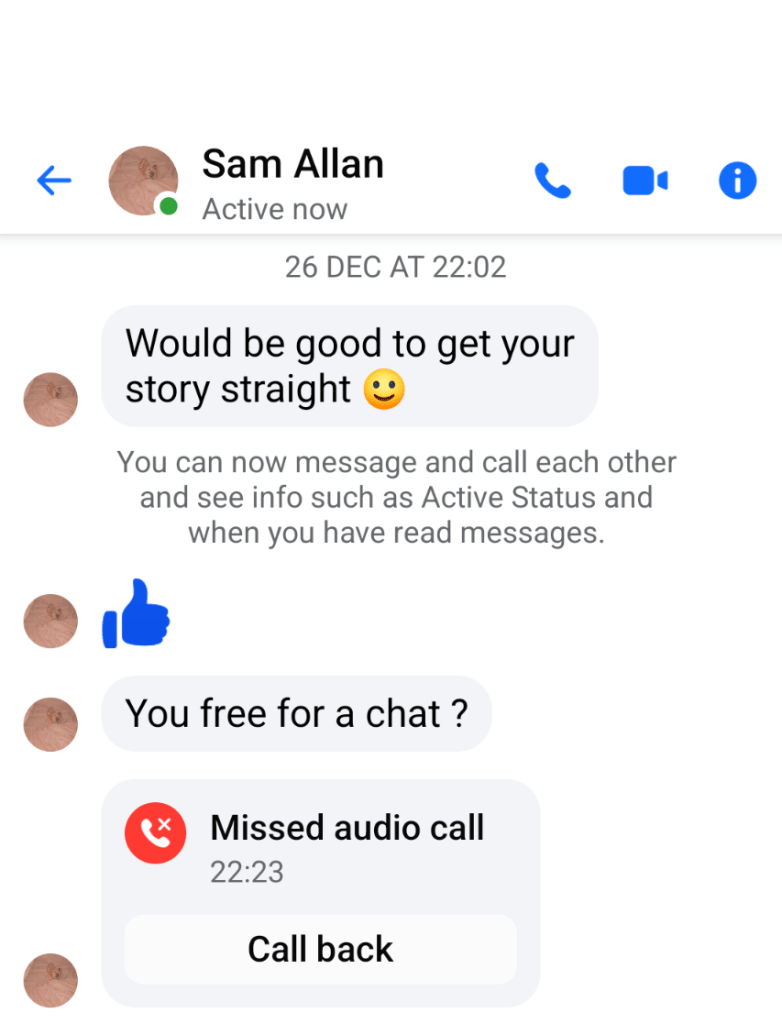
On 26 December at 22:02, Miller (who uses the name Sam Allan on Facebook) sent me a friendly-seeming message: “Would be good to get your story straight 😊.” He attempted a phone call at 22:23, which I missed. Then: silence.
For six days, nothing. No follow-up, no further contact. Then, on 1 January at 17:25, a voice message arrived. The tone had changed completely.
The 8pm Ultimatum
“Sophie, I haven’t checked yet. Obviously I’ve been busy over the Christmas time. I’m guessing that you’ve changed, amended or deleted the article and taken my name out of there. Obviously if you haven’t then I’m going to have to reply. Bearing in mind when I reply it’s not going to be nice.”
He continued:
“In my view you’re basically sticking up for paedophiles and seeing they’ve been wronged when they haven’t. I’ve got a page which basically gets 11 million views every month and I’ve got a quarter of a million followers. You’ve got 5,000. So it doesn’t take a brain surgeon to work out who’s going to get the most coverage.”
The message ended with a deadline:
“If I check later on and obviously there’s incorrect information in there then I’ll have to post it to set the record straight. So it’s your call. Just let us know. You’ve got till I’ll give you 8 o’clock.”
There it was: platform leverage, follower-count intimidation, a ticking clock, and the familiar vigilante smear, questioning their methods framed as “sticking up for paedophiles”.
The Escalation
At 19:08, I responded professionally, establishing my credentials and the factual basis of my reporting. I stated clearly:
“I’m an NUJ-accredited investigative journalist. Every detail about your false imprisonment conviction in my article is verified against court records, Judge Clemitson’s sentencing remarks, and Northumbria Police statements. Your threat to use your 250k followers against me for publishing factual journalism, complete with an 8pm deadline, is precisely the intimidation pattern the article examines. This conversation is fully documented. The article stands.”
What followed was a rapid escalation.
19:30 — Personal attacks began:
“You a recovering smackhead?” followed by appearance-based harassment and concern-trolling about my mental health.
19:39 — Threats escalated:
“I’ve got your ex partner in my inbox now revealing all.”
“Not going to end well.”
He claimed he would spread the campaign across “5 other pages and TikTok and Insta”.
20:26 onwards — Direct intimidation:
“I have your address which I could also legally post. Shall we go there? I dont mind.”
When I called this a threat, he replied:
“How’s that a threat? Its public accessible information which I’m saying I can share.”
20:47 — Credibility attacks:
“Just checked you arent a registered journalist ahahaha. Its clearly expired. Because there’s nothing active in your name.”
This was false. My NUJ accreditation is current and verifiable.
21:46 — He revealed he was messaging others in my professional network, attempting to damage my reputation across multiple platforms.
The Public Smear
That same evening, Miller published a post on his Child Online Safety Team (COST) page titled “Sophie lewis – self styled reporter.” The post claimed I “repeatedly published articles criticising paedophile-hunting groups,” that my work contained information that was “neither factually accurate nor properly verified,” and concluded:
“Our concern is, why would someone go out of the way to defend those who abuse kids.”
Every claim was false. But that is precisely the function of such smears: once the accusation of “defending paedophiles” is made publicly, reputational damage occurs regardless of truth.
Miller has since deleted this post.
The Documentation
As a journalist who had just spent weeks researching intimidation tactics, I recognised what was happening in real time. So I did what journalists do: I documented it.
On 1 January, I published a comprehensive breakdown on a safeguarding platform where I had served as an administrator for 18 months. The post included timestamped screenshots, the voice message recording, analysis of Miller’s tactical progression, and court record citations. I titled it to reflect the same intimidation patterns analysed in my original article.
The post was evidence-based, factual, and meticulously sourced. It was also, apparently, too much truth for institutional comfort.
The Choice
Shortly after publishing my documentation, I was asked to remove it. The reason given: to “keep the peace”.
Let that sink in. After 18 months of contributing to a safeguarding platform, I was asked to delete a timestamped, screenshot-evidenced account of journalist intimidation, not because it was inaccurate, but because it might cause conflict.
I faced a choice: remove documentation of harassment to preserve organisational relationships, or maintain journalistic integrity and walk away.
When keeping the peace means silencing accountability, the institution has already chosen a side.
I chose journalism. I walked on New Year’s Day.
What This Reveals
Miller’s response aligned closely with the structural concerns raised in my original article. The tactics used, platform leverage, deadline pressure, personal attacks, credibility challenges, the “defending paedophiles” smear, multi-platform harassment, and threats framed as public information sharing are not unique to one individual. They are patterns that emerge when groups operate without professional oversight or accountability frameworks.
But the institutional response reveals something equally troubling: how organisations that claim to prioritise safeguarding can prioritise comfort over truth when confronted with documented evidence of intimidation.
This is not unique to one platform. It reflects a broader pattern across safeguarding spaces where questioning methods is reframed as attacking the mission; where accountability is treated as betrayal; and where institutions choose appeasement over evidence.
The chilling effect is real. When journalists face coordinated harassment for reporting documented facts, and when organisations ask them to delete evidence rather than stand behind verified material, accountability journalism becomes unsustainable.
Why This Matters
I’m not writing this for sympathy or protection. I’m writing it because the pattern matters.
Vigilante groups claim to protect children. Some genuinely do important work within appropriate boundaries. But when criticism of methods triggers intimidation campaigns, when factual reporting is met with smear tactics, and when institutions retreat rather than defend truth, the focus shifts from protection to power.
The irony is striking: I wrote about how some vigilante operations replicate coercive dynamics. The response mirrored those dynamics. I documented how critics are pressured. The documentation itself became the target.
Miller gave me a deadline. I gave him evidence. He wanted silence. He got a case study.
The Work Continues
Every message Miller sent is now part of the record. Every tactic he used has been documented and analysed. The institutional response has been noted and will inform future reporting on how safeguarding organisations handle accountability challenges.
This is what accountability journalism looks like: evidence-based, meticulous, and unwilling to be silenced by intimidation or institutional pressure.
To other journalists covering vigilante operations: document everything, verify twice, and don’t back down when the backlash comes. Your accreditation matters. Your sources matter. Your integrity matters more than any organisation’s comfort.
To survivors and advocates: watch who responds to scrutiny with evidence and who responds with intimidation. That difference matters.
And to those who believe questioning tactics means defending abusers: genuine child protection does not require silencing journalists. Accountability strengthens safeguarding. Transparency builds trust. Intimidation reveals weakness.
The article Miller tried to silence remains published. This one joins it.
The work continues.
Sophie Lewis is an NUJ-accredited investigative journalist specialising in institutional safeguarding failures and predator behaviour patterns. She runs The Grooming Files an independent platform focused on accountability journalism in child protection. She is a final-year BA (Hons) Social Sciences student at the Open University, specialising in criminology and forensic psychology.

 The Grooming Files
Leave a comment