
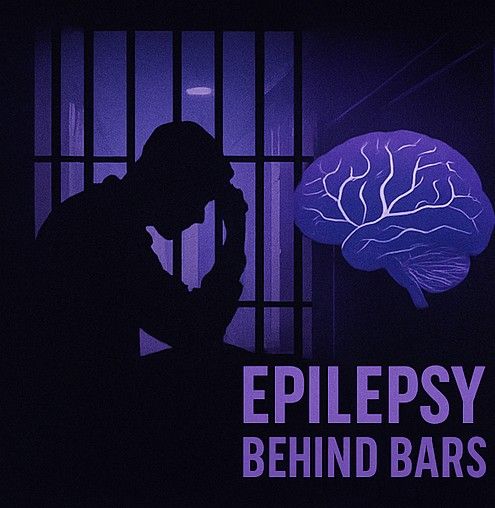
Opinion | Sophie Lewis | November 2025
Prisoners with epilepsy are dying at four times the rate of people in the community. Not because epilepsy is untreatable, but because the systems meant to keep them alive consistently fail to follow the most basic clinical standards. These deaths are not tragic mysteries — they are predictable outcomes of institutional neglect.
We Already Understand Epilepsy. We Just Don’t Apply That Knowledge.
Epilepsy is not a mysterious condition. It is one of the most researched, most understood, most treatable neurological disorders in medicine. We know what causes seizures. We know how to prevent them. We know what increases the risk of sudden death. We have known these things for decades.
And yet, according to the Prisons and Probation Ombudsman’s report published today, prisoners with epilepsy are dying at four times the rate of people in the community. Not because their condition is more severe. Not because prison healthcare lacks the tools to help them. But because the systems designed to keep them alive simply do not function.
I have spent years documenting institutional failures—the ways our systems let vulnerable people fall through cracks that should never have existed. But this report represents something different. This is not a gap in the system. This is the system working exactly as designed: processing people rather than caring for them, managing risk on paper while ignoring it in practice.
Only 38% Had a Care Plan — This Is Not a Resource Problem
Only 38% of prisoners with epilepsy had a documented care plan. This is not a resource problem. It is a priorities problem.
Consider the simplest finding in the PPO’s research: only 38% of prisoners with an epilepsy diagnosis had a documented care plan. A care plan is a piece of paper. It costs nothing to produce. It requires no specialist equipment, no additional staffing, no budget allocation. It requires only that someone sit down and write: this person has epilepsy, these are their triggers, this is their medication, this is what to do in an emergency.
62% of prisoners didn’t have this basic document. When they seized in their cells, staff had no guidance. When they transferred prisons, their medical history travelled as rumour rather than record. When they died, clinical reviewers could only note that care was not equivalent to that available in the community.
This is not a resource problem. It is a priorities problem. And it reflects a deeper truth about how we view people in prison: as problems to be managed, not patients to be treated.
A Woman Died in the Gaps Between Responsibilities
The report documents a woman whose anti-seizure medication was reduced without adequate co-ordination with mental health services. She became severely anxious. She was placed on suicide watch. Healthcare staff never participated in her suicide prevention meetings. The doctor who reviewed her medication on the day she died didn’t know she was on an ACCT. She died by hanging.
Every failure in her case was a communication failure. The medication decision, the mental health impact, the suicide prevention protocol—each existed in its own silo, each managed by professionals who apparently never spoke to each other about the woman they were supposed to be helping. She died in the gaps between their responsibilities.
This siloed approach to human beings is not unique to prisons. I have seen it in every institution I have investigated. Social services that don’t talk to schools. Police that don’t share intelligence with child protection. Healthcare that exists on paper but not in practice. The result is always the same: people die, and everyone can point to someone else’s failure while absolving themselves of responsibility.
People in Prison Have No Alternatives
But prisons are different in one crucial respect. People in prison have no alternative. They cannot choose a different GP if their needs aren’t being met. They cannot take themselves to A&E if they feel a seizure coming on. They cannot refuse a cell transfer that will disrupt their care. They are entirely dependent on an institution that the PPO’s research suggests cannot be depended upon.
The state made a choice to put these people in custody. That choice comes with obligations. The duty to provide healthcare equivalent to that in the community is not aspirational—it is a legal requirement. When 42% of prisoners who should have had annual epilepsy reviews didn’t receive them, when prisoners transferred without their medication, when seizure frequency increased without any monitoring or specialist referral, the state failed in its most basic duty of care.
These are not medical mysteries. They are bureaucratic homicides.
Seizure-Free Rates as Low as 0.2% — A System Not Functioning
I keep returning to one statistic from the report: in the community, up to 70% of people with epilepsy can live seizure-free with proper treatment. In prison, recent research found that figure as low as 0.2%. Not 2%. Not 0.2% difference. 0.2% total. That is not a failure to achieve excellence. That is a failure to function at all.
The PPO’s Recommendations Are Not Revolutionary — They Are Basic Competence
The PPO’s recommendations are measured, practical, achievable. Ensure care plans exist. Follow medication protocols. Transfer prisoners with their medication. Don’t put people who have seizures on top bunks. These are not revolutionary demands. They are the bare minimum of competent care. That they need to be stated at all—that an Ombudsman must publish a bulletin reminding healthcare professionals to follow their own guidelines—tells us how normalised this neglect has become.
Prisons will say they are overcrowded. They will say they are underfunded. They will say they are doing their best under difficult circumstances. All of this may be true. None of it excuses leaving 62% of prisoners with epilepsy without a care plan. None of it excuses the 34% of prisoners with epilepsy in this sample who died by suicide. None of it excuses the basic failures of communication, protocol and humanity documented in case after case.
The uncomfortable truth is that we do not actually believe prisoners deserve equivalent healthcare. We may say we do. We may have policies that claim we do. But when resources are scarce, when attention is divided, when difficult choices must be made, we consistently choose to provide prisoners with less. The PPO’s report is evidence of that choice, repeated across 125 deaths over 10 years.
These Were Preventable Deaths — Killed by Neglect, Not Epilepsy
These were not complicated cases. Epilepsy is manageable. SUDEP is largely preventable. The prisoners in this report died because care plans weren’t written, because medications weren’t transferred, because seizures weren’t monitored, because officers weren’t trained, because protocols weren’t followed. They died from paperwork failures and communication breakdowns and institutional indifference.
They died, in other words, from our choices. From our collective decision that their lives mattered less, that their healthcare could be deprioritised, that their deaths would be acceptable losses in a system designed to warehouse rather than rehabilitate.
We Know What Needs to Change. The Question Is Whether We Care Enough.
The PPO will work with NHS England and HMPPS on recommendations. Lessons will be learned. Actions will be formulated. And in ten years, another Ombudsman will likely publish another bulletin documenting another decade of preventable deaths.
Unless we decide differently. Unless we decide that a prisoner with epilepsy deserves a care plan. That a medication protocol exists to be followed, not filed. That a transfer should include the medication the prisoner needs to survive. That a seizure is a medical emergency even if the patient has used drugs. That sleeping alone is a risk factor worth addressing. That a person remains a patient even when they are also a prisoner.
These are small decisions. They require no legislation, no budget increase, no policy revolution. They require only that we treat incarcerated people as human beings worthy of basic medical care. The PPO has shown us exactly where we are failing and exactly what needs to change.
The only question now is whether we care enough to do it.
Sophie Lewis is an NUJ-accredited investigative journalist and founder of The Grooming Files. She specialises in institutional safeguarding failures and systemic neglect.

 The Grooming Files
Leave a comment