

Part 5 of The Record They Buried – And the Woman Who Survived It
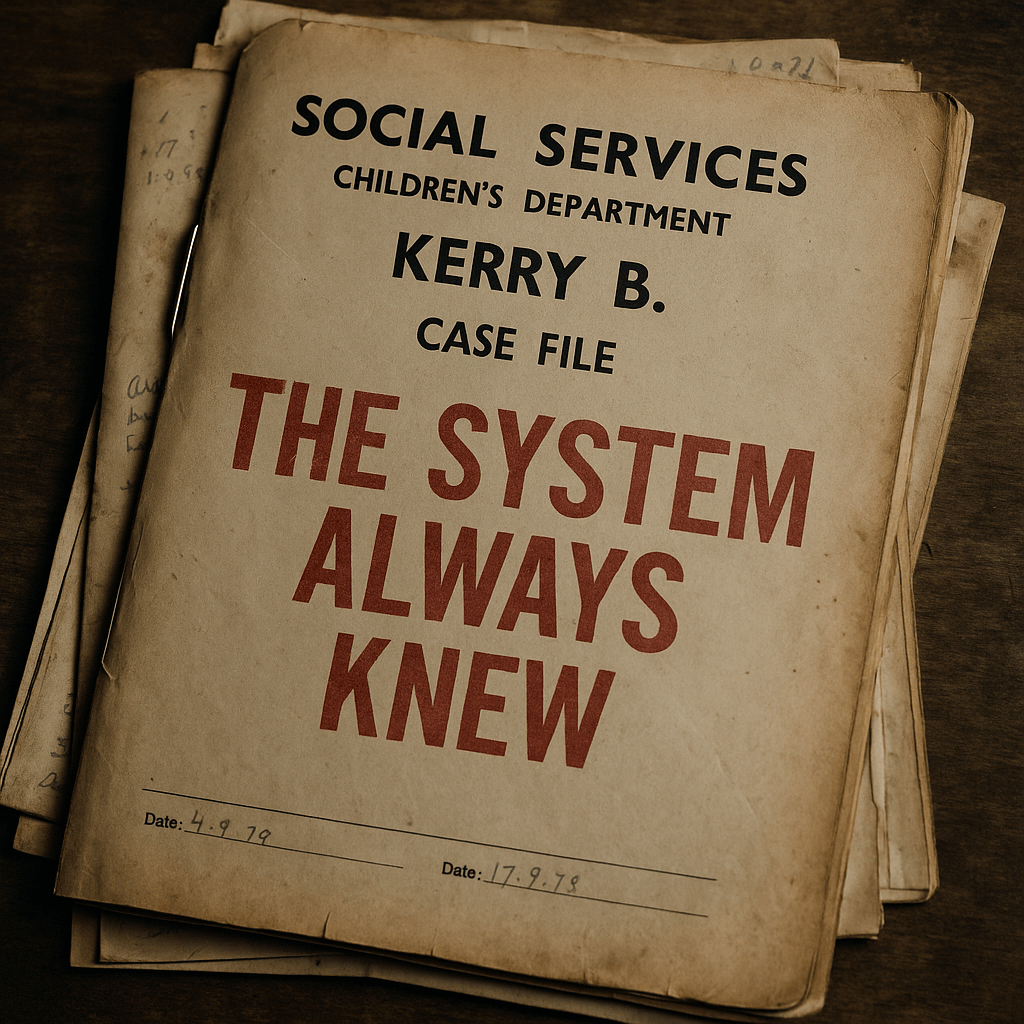
You don’t end up with over 1,000 pages of care records by mistake. That kind of trail only exists when someone has cried out for help over and over again and still been left to survive alone. Kerry’s file isn’t a mystery. It’s a slow, brutal confession written by the institutions that watched her suffer.
They wrote that she was unwashed. That she flinched. That her mother “did not seem to have much time for the child.” They documented her bruises. Her missed school days. Her silence. Her fear.
They knew she didn’t feel safe. They knew she wasn’t being fed. They knew she was sleeping in an armchair soaked in urine because she wasn’t allowed a bed.
And they let it happen anyway.
Her life was recorded. But never protected.
This Wasn’t Neglect. It Was Strategy.
People talk about “children slipping through the cracks.” Kerry didn’t slip through anything. She was placed in the cracks, deliberately, by professionals who saw just enough to be concerned, and chose to leave her anyway.
Because the truth is, it wasn’t that they didn’t know. It was that they didn’t want to deal with it.
Time and again, she was labelled the problem. Too angry. Too emotional. Too quiet. Too loud.
They pathologised the symptoms instead of stopping the cause.
“Catherine is withdrawn.” “Catherine is hostile.” “Catherine blinks a lot and struggles to form attachments.”
But not once did they name the trauma for what it was, a direct consequence of repeated neglect, emotional abuse, physical violence, and unrelenting fear.
She wasn’t mentally unwell. She was a child trying to survive without safety.
The Paper Trail Is the Truth
Over five decades later, Kerry holds that paper trail in her hands. And now so do we.
We have the full record of who knew what, when. Every school note, every clinic memo, every home visit that ended in “no further action.”
We have social workers writing:
“She would be better in care.” “The mother cannot cope.” “The child looks tired and frightened.”
And then we have them writing:
“No placement available.” “Too old to be taken in without resistance.” “Will monitor the situation.”
This wasn’t safeguarding. This was risk management, for the adults. Not the child.
A New Generation, The Same Silence
You would think the point of records is to learn from them. To improve systems. To stop the next child from going through it.
But Kerry says the same thing is happening again, only now it’s her grandson. She’s seen it. She says the bruises are there. The fear is there. The lies are there. And the silence? It’s louder than ever.
She’s reported concerns. Taken photos. Been to meetings. And just like when she was a child, she’s been labelled a problem instead of a witness.
“They haven’t learned a thing. They talk about safeguarding but they’re still not listening.”
This isn’t a broken system. This is a system that functions exactly as it was designed: to avoid liability, to manage image, to move cases forward, not to protect.
What Justice Really Means
Kerry doesn’t want pity. She doesn’t want to go viral. She wants justice. And for her, justice doesn’t mean punishment, it means protection.
“I just want my grandson to be safe. I want him to grow up feeling loved and listened to. I want to stop this from happening again.”
Justice means professionals reading the records and actually responding. Justice means not letting a child’s warning signs become another archived case. Justice means believing survivors, not decades later, but right now, when it matters.
We Can’t Say We Didn’t Know
Kerry’s story is not a cautionary tale. It’s a warning shot. And it’s loaded with names, dates, signatures, facts.
This isn’t about memory. It’s about evidence. It’s about a woman who kept her files, who never gave up, who speaks now not just for herself but for every child the system conveniently forgets.
“They always knew,” she says. “And they still did nothing.”
So we ask:
- How many more children have to be broken before this changes?
- How many more survivors have to relive their pain through their grandchildren?
- How many more families have to scream into silence before someone listens?
This is the end of the series. But it cannot be the end of the conversation.
Because if we look away now, we’re no better than the ones who wrote those notes.
The system knew. It always knew. And it still did nothing.

 The Grooming Files
Leave a comment