
©️ By Sophie Lewis | The Indie Leaks | The Grooming Files | @realtalkrealtea

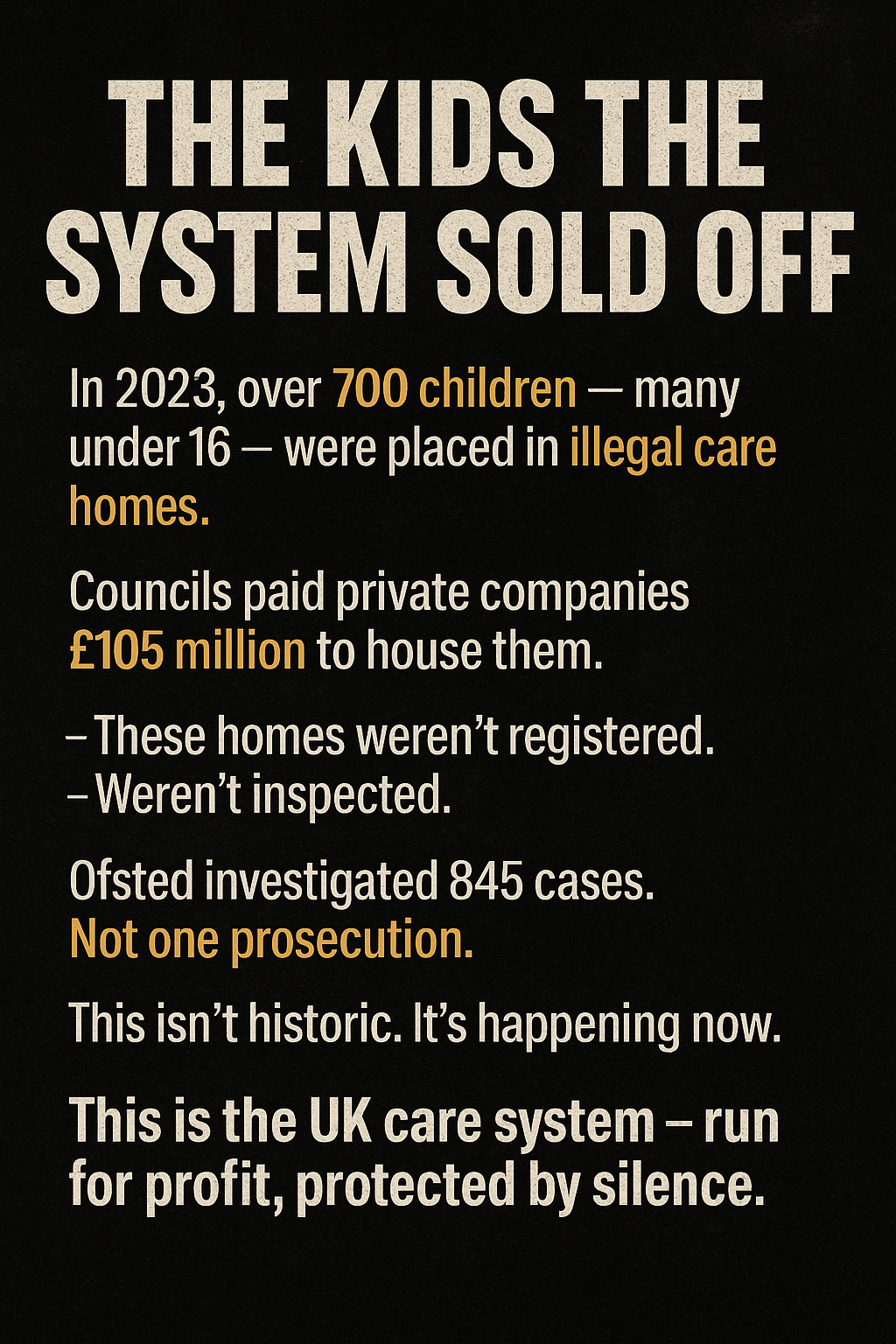
They weren’t just failed. They were sold off — placed in illegal homes, far from their families, in buildings never meant for care, by systems that knew exactly what they were doing.
Across England and Wales, vulnerable children are being placed in unregistered, unregulated, and illegal care settings — and those responsible aren’t being held to account.
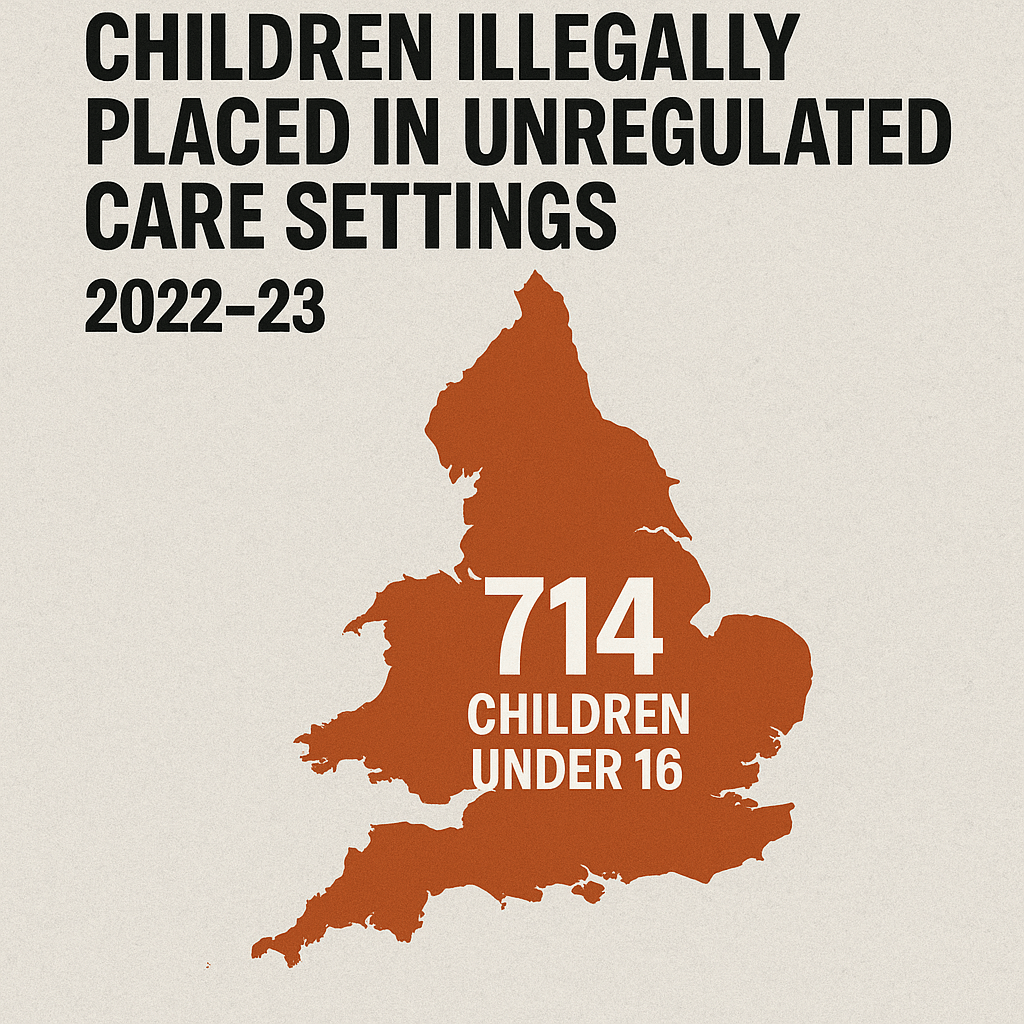
In 2022–23 alone, English councils placed at least 724 children under 16 into unregulated placements — a direct violation of the law. In Wales, 92 unregistered homes were uncovered by Care Inspectorate Wales, many arranged directly by local authorities. Some children were just 11 years old. Most were isolated, unstable, and at immediate risk.
This isn’t historic. This is still happening — quietly, routinely, and without justice.
What the Law Says — and How It’s Ignored

In both England and Wales, the law is clear: children under the age of 16 cannot legally be placed in unregistered care homes.
In England, the Care Planning, Placement and Case Review Regulations were updated in 2021 to reflect that. In Wales, it has long been a legal requirement for children’s homes to be registered with Care Inspectorate Wales (CIW). Unregistered settings are considered illegal — and unsafe.
And yet, the practice continues.
In England, the Children’s Commissioner confirmed that councils placed hundreds of under-16s in unregulated settings between 2022 and 2023. Ofsted received reports of 845 illegal placements that year — but not one prosecution followed.
In Wales, 92 services were identified by CIW as operating without registration — some repeatedly used by councils, with staff lacking training or safeguarding protocols. One report revealed councils “knowingly breached the law” to secure emergency placements.
These are not technicalities. These are children being placed in danger — knowingly, and sometimes strategically — by the very systems designed to protect them.
The Numbers They Hide
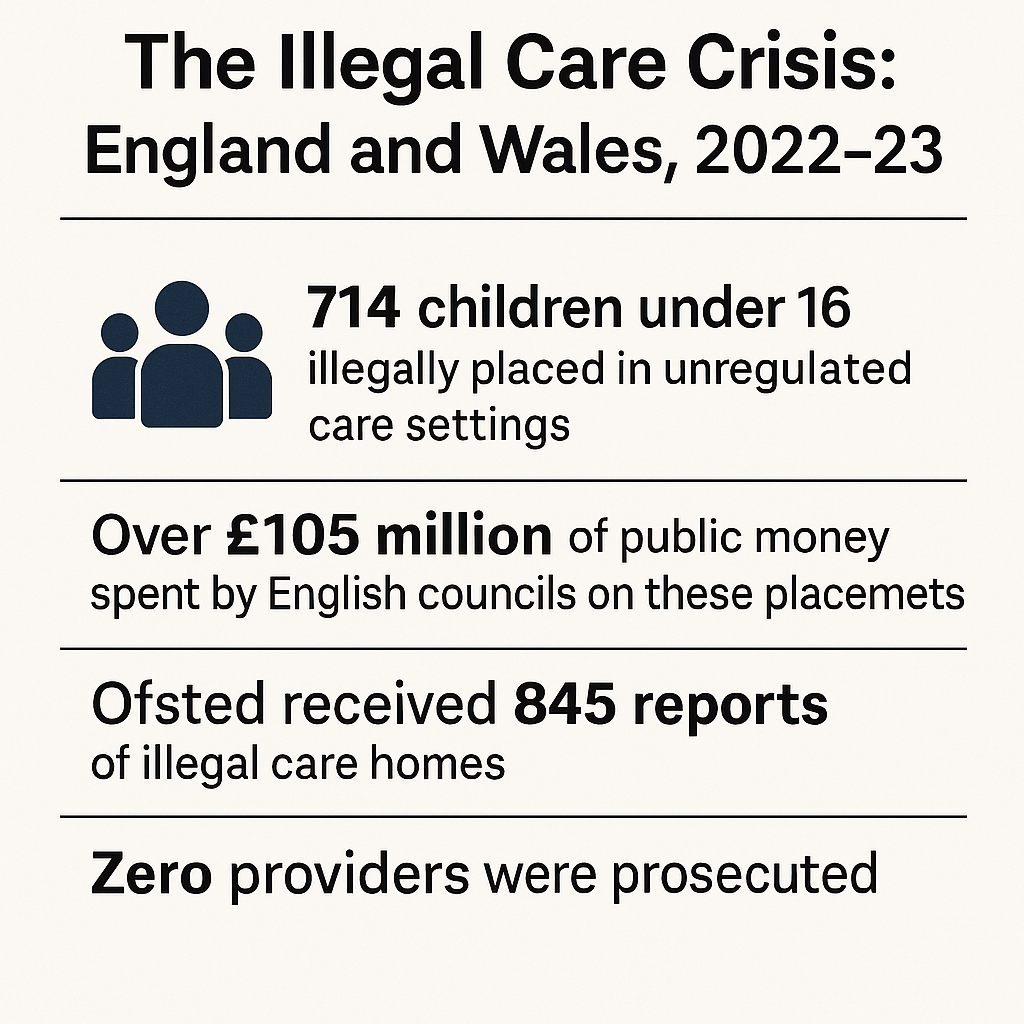
On paper, these are just numbers. In reality, they’re stories of harm — hidden behind spreadsheets and buried in annual reports.
England
In 2022–23:
- 724 children under 16 were illegally placed in unregulated care settings
- Over £105 million of public money was spent by English councils on these placements
- Ofsted received 845 reports of illegal care homes
- Zero providers were prosecuted
Many of these placements were made in so-called “semi-independent” settings — often with no carers present overnight, no formal inspections, and no therapeutic support. Some of the children placed were as young as 11. Several were on child protection plans. All were legally entitled to care. Few received any.
Wales
In the same year:
- 92 unregistered settings were discovered by Care Inspectorate Wales (CIW)
- These included homes used repeatedly by councils, despite prior warnings
- In multiple cases, premises were never designed to house children — including B&Bs and makeshift flats
- CIW described these as “unlawful and unsuitable” — yet many remained open
In one case, a young girl with severe trauma was moved across three illegal homes in under four months. In another, a teenage boy was placed with rotating agency staff with no safeguarding checks in place. Local authorities cited “placement pressure” as justification — but CIW found some councils were failing to even try legal routes before turning to unregistered providers.
The Cost of Convenience
Across both countries, the trend is the same: public money flows into unregulated, often dangerous placements — with little to no transparency. On average:
- These placements cost £140,000–£160,000 per child per year
- That’s more than double what many registered homes charge
- And far more than what councils would spend on early intervention or trauma-informed support
Yet year after year, this continues. Because it’s easier. Because it’s cheaper. Because, on paper, it ticks a box: “child placed.”
Survivor Voices – What It Feels Like Inside
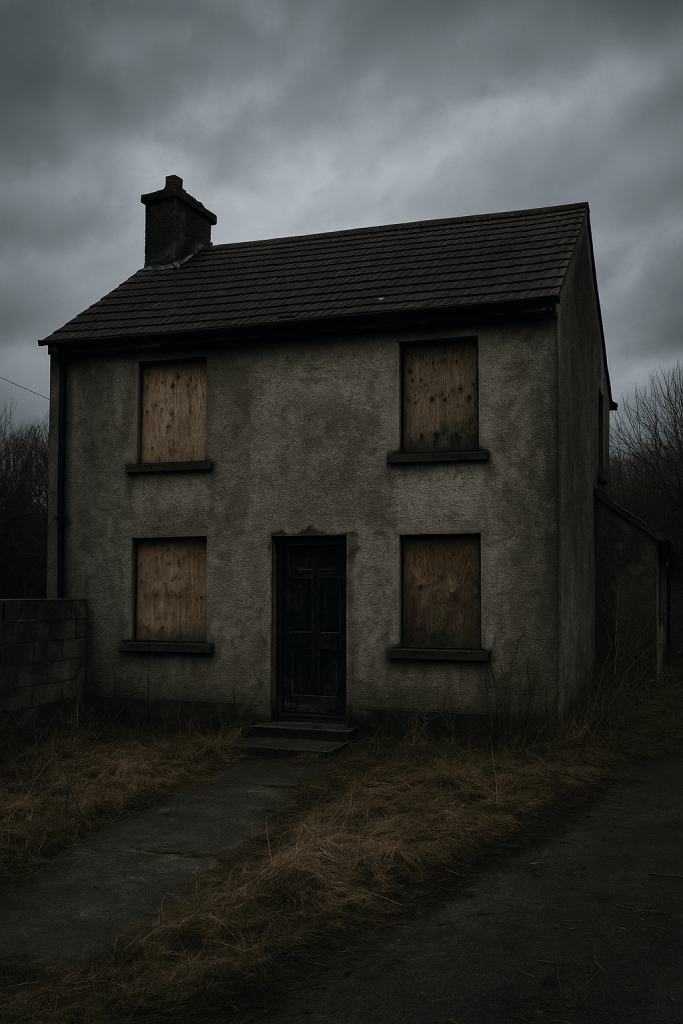
Behind every statistic is a child who remembers.
Their names are hidden, but their stories aren’t.
“I was 14. I’d already been hurt at home. Then they put me in a house with no staff. Just a key and a rota.”
– Anonymous care leaver, England
She had been removed from an abusive household. Then, with no registered placement available, her council placed her in a privately-run “semi-independent unit” — a converted flat with no permanent staff, just visiting agency workers. There were no school arrangements. No therapy. No routine.
She went missing within a week.
“They moved me to a town I’d never heard of. I was 200 miles away. I didn’t know a soul.”
– Young person, unregistered home in South Wales
In Wales, the issue is often invisible. One teenage boy with ADHD and PTSD was placed in three different unregistered homes in under six months. Each time, he was moved by taxi — with little notice. One property had broken locks. Another had no heating. In one, he shared the space with an older child who’d been in trouble with the police.
He told CIW inspectors he felt “dumped and forgotten.”
“There was no one at night. Just me and the silence. If something happened, who would know?”
– Former resident, illegal home in the North West
This is the silent core of the scandal: children left to parent themselves in the name of “independence.” No permanent adult presence. No regulated support. No one checking they’re even safe.
Inspectors found children cooking for themselves, managing medication, and living in settings described as “inappropriate and isolating.” One child in a 2023 review had been missing 13 times before a care plan was even updated.
For many, the trauma of unregulated care runs deeper than their original reason for entering the system. Because at least at home, they say, someone knew their name.
Profiting from Pain – The Companies Cashing In
While children are moved between unsafe placements and unregulated flats, someone’s balance sheet is booming.
In 2022–23, English councils paid over £105 million to private providers operating unregistered or semi-independent homes. In Wales, though profit-making in children’s care is now being phased out, the shadow of private contracts still looms large.
The Business of “Care”
Many of the companies running these settings describe themselves as “specialist providers” of support. But inspections, reports, and whistleblower testimonies reveal a different picture: empty rooms, untrained staff, inflated fees — and no care at all.
Among the most frequently named are:
- Care 4 Children – previously found operating homes without proper registration; faced serious concerns in Ofsted reports
- Keys Group – one of the largest providers in the UK; previously ran homes with safeguarding failures but continued to win public contracts
- Calcot Services for Children – received millions in council funding while homes were cited for inadequate standards
These companies don’t just run one or two homes. Some operate across multiple local authorities, taking on children hundreds of miles from their families. In several cases, one company ran three or more “homes” on the same street — placing highly vulnerable children side-by-side with little oversight.
The Profit Margin
Councils often pay between £2,500 and £4,000 per week, per child for these placements — even when they’re technically illegal.
Yet many staff in these homes earn close to minimum wage.
Some receive no specialist training in trauma, safeguarding, or child development.
Several inspections found lone working practices where a single worker was left responsible for multiple high-needs children overnight.
That profit doesn’t vanish. It goes to CEOs, shareholders, and in some cases, private equity firms. In 2021, a report by the Children’s Commissioner warned that the marketisation of children’s care was leading to “unacceptable financial risk and moral failure.” That warning was ignored.
And so the cycle continues. Children pay the cost.
Companies collect the invoice.
Ofsted’s Inaction and Political Silence
When children are placed in dangerous settings, there’s one body meant to intervene.
That body is Ofsted in England — and Care Inspectorate Wales (CIW) across the border.
But despite hundreds of warnings, reports, and red flags, neither regulator has used their full powers to hold providers or councils accountable.
845 Reports. Zero Prosecutions.
In 2022–23, Ofsted received 845 alerts about children being placed in illegal, unregistered homes. It investigated. It warned. It advised.
It prosecuted no one.
Not one private company was taken to court. Not one council was fined. Not one provider lost their ability to continue operating.
Why? Ofsted claimed a “supportive approach” was more productive — encouraging homes to seek registration rather than punishing breaches.
But as one whistleblower told The Observer:
“It’s become a game. They’ll shut one home and open another across the road. Ofsted knows. Everyone knows. But nothing changes.”
CIW: ‘Unlawful and Unsafe’ — But Still Operating
In Wales, CIW identified 92 unregistered services operating during the same year — many of them repeatedly used by councils. In its own words, these homes were “unlawful” and “unsuitable for children’s needs.”
Yet even with that language, most were allowed to continue operating. No criminal action was taken. No emergency reforms were imposed.
Instead, local authorities were simply advised to “reduce their reliance” on such placements — a soft phrase for an illegal practice.
Political Silence, Empty Promises
In Parliament, questions have been asked. Reports have been written. Pledges have been made.
But change has been slow, fragmented, and shallow.
In England:
- The government promised “urgent reform” in 2021
- Yet by 2023, hundreds of under-16s were still being placed in illegal settings
- A national strategy to end unregulated placements remains unpublished
In Wales:
- A landmark bill passed in 2025 to phase out profit in children’s care
- But the transition won’t be complete until 2030
- In the meantime, local authorities still rely on temporary, unregulated solutions when capacity runs out
There is no national emergency declared. No inquiry. No justice for the children already harmed.
When a system fails this hard — and no one is held accountable — it becomes clear: this isn’t neglect. It’s permission.
What Needs to Happen Next
This isn’t just a policy failure. It’s a moral collapse.
Children are being housed in illegal buildings, by untrained staff, under the noses of the very people paid to protect them. No more reviews. No more gentle guidance. What’s needed now is action — hard, urgent, unapologetic action.
We need:
- Immediate criminalisation of placing any child in an unregistered setting — not just under-16s
- Emergency powers to shut down illegal homes and block providers who rebrand to avoid detection
- Whistleblower protections for frontline staff raising concerns about illegal or dangerous care
- A publicly searchable registry of care providers, ownership structures, and inspection histories
- An independent watchdog to investigate systemic placement breaches across all UK nations
- Direct input from care-experienced young people into national policy and placement reviews
The system cannot fix itself. It has shown us that again and again. Reform must be led by survivors, watchdogs outside of government, and those brave enough to blow the whistle from inside.
Not One More Child
They’ll say there’s not enough money.
They’ll say it’s a placement crisis.
They’ll say they’re doing their best.
But what do we say to the 14-year-old left alone in a room with no staff?
What do we say to the girl moved across four illegal homes in a year?
What do we say to the children who went missing — and never came back?
We say this:
You were never the problem.
They were.
You were never the burden.
They cashed in.
You were never too hard to love.
They were too cold to care.
This is not a historic failure.
It’s a living one.
And we say clearly now:
Not one more child.

 The Grooming Files
Leave a comment